













































Embedded systems run medical devices, factory controllers, vehicles, meters, and network gear, and attackers now treat them as a route into larger networks. Verizon’s 2025 Data Breach Investigations Report found that exploiting vulnerabilities started 20% of breaches, a 34% increase over the previous year. Edge devices and VPNs made up 22% of those exploitation targets, up from 3% in 2024. IBM’s 2026 Cost of a Data Breach Report puts the global average breach cost at $4.99 million, and breaches now take 247 days on average to identify and contain. Regulation adds pressure. Under the EU Cyber Resilience Act, manufacturers must report vulnerabilities and incidents within 24 hours from September 11, 2026, with fines of up to €15 million or 2.5% of global turnover.
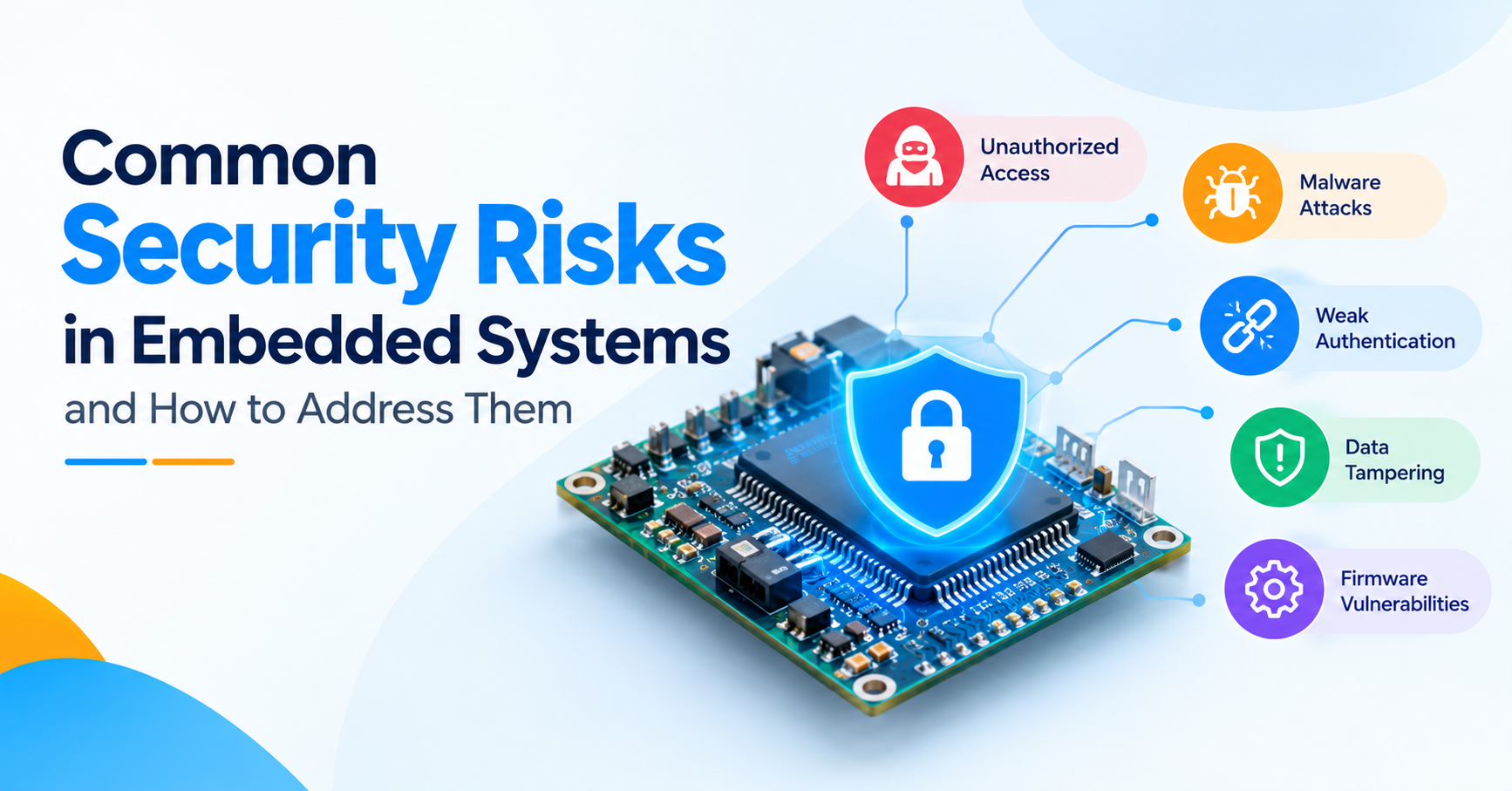
The short answer to the title question is this. The most common risks are weak credentials, unsigned firmware, memory-safety bugs, unencrypted traffic, exposed debug ports, vulnerable third-party code, and missing patch paths. Teams reduce them with layered controls across hardware, firmware, network, and process. The sections below explain each risk, the fix that works in practice, a real incident, and the business return.
Why Embedded Systems Are Harder to Secure Than Standard IT
Embedded devices break several assumptions that enterprise security tools rely on. Four traits create most of the difficulty.
Most devices have small processors, limited memory, and tight power budgets, so full security agents rarely fit. Product lifecycles run for years, and many manufacturers build these systems expecting that no one will update them. Attackers can often touch the hardware, which opens paths that cloud servers never face. Each device is also customized, so a fix for one product rarely transfers to the next.
Security therefore has to start at design. As one embedded engineering firm puts it, security is never perfect and needs attention across the product’s whole life as threats change.
Common Security Risks in Embedded Systems and How to Fix Them
The seven risks below recur across public research and incident reports. Each one pairs with the control that reduces it most.
Remove Default and Hardcoded Credentials
The OWASP IoT Top 10 ranks weak, guessable, or hardcoded passwords as the number-one IoT risk, and Vectra reports roughly 20% of devices still ship with default credentials. One shared password across a product line turns a single leak into a fleet-wide breach.
Provision a unique credential for every device during manufacturing. Force a change at first use, keep shared keys out of the firmware image, and store secrets in a secure element or protected key store.
Sign Firmware and Secure the Update Path
A device that accepts unsigned firmware lets an attacker install modified code that survives reboots. Update channels without authentication or rollback protection create the same exposure. Speed matters as well, since Flexera, summarizing Verizon’s report, points to a 32-day median patching time.
Root the boot process in hardware, verify every image signature before execution, and add anti-rollback counters. Deliver over-the-air updates through authenticated, encrypted channels. Keep a recovery partition so a failed update does not brick the device.
Eliminate Memory Safety Bugs in C and C++ Code
Most firmware is still written in C or C++, where buffer overflows, use-after-free errors, and integer overflows can give an attacker remote code execution. These flaws often sit in code that handles untrusted input, such as network stacks and protocol parsers.
Apply a secure coding standard like MISRA C or CERT C, and run static analysis in every build. Fuzz each parser, enable compiler protections such as stack canaries, and use the memory protection unit to isolate tasks. Write new parsing modules in a memory-safe language like Rust where your toolchain supports it.
Encrypt Communication and Use Proven Cryptography
Plaintext protocols expose credentials and sensor data to anyone on the network path. Custom ciphers, weak random number generators, and unmanaged certificates cause quieter failures.
Use TLS 1.3 or DTLS with mutual authentication through device certificates. Choose vetted libraries over custom code, and generate keys from a hardware random number generator. Plan certificate rotation before the first device ships, and protect keys in hardware instead of general flash.
Lock Down Debug Ports and Physical Access
JTAG, SWD, and UART exist for engineers, but an attacker who finds them open can read memory, extract keys, or inject faults. Academic work on embedded security notes that attackers can read memory contents and inject faults, and that even debug printouts can become a security risk.
Disable or authenticate debug access on production units, set readout protection fuses, and strip verbose logging from release builds. For high-value devices, add tamper-resistant enclosures and tamper detection.
Control Third-Party and Open-Source Components
A typical firmware image bundles an RTOS, a network stack, and dozens of libraries. Over multi-year lifecycles, firmware components and third-party libraries can reveal vulnerabilities. Supplier risk is growing too, because the share of breaches involving third parties doubled from 15% to 30%.
Keep a software bill of materials (SBOM), track CVEs against it, and pin component versions. When teams buy embedded software services from an outside partner, they should require an SBOM, signed builds, and written patch timelines in the contract.
Plan for Patching Over the Product’s Full Life
A device that cannot update in the field turns every future vulnerability into a permanent one. Support periods that end quietly leave customers exposed.
Design over-the-air updates from the first prototype and publish a support period. Run a product security incident response process that can triage reports quickly. That process also supports the 24-hour reporting that the Cyber Resilience Act now requires.
Build Security Into the Development Lifecycle
Controls added late cost more and cover less. Security work should follow the product from the first requirements meeting to the last release.
- Threat modeling at design. List assets, entry points, and attacker types before writing code.
- Layered defenses. Cover hardware, system architecture, and software. Software security is the least-implemented layer, especially on devices that never connect to the internet.
- Automated checks. Run static analysis, dependency scanning, and fuzzing in continuous integration.
- Hardware testing. Penetration-test production-representative boards, including debug interfaces and side channels.
- Controlled releases. Use signed, reproducible builds and guard release keys.
Each item gives auditors and customers evidence that security was designed in, not added at the end.
Meet Regulatory and Industry Standards
Compliance now shapes embedded design choices, and the deadlines have already started.
The Cyber Resilience Act’s reporting duties apply from September 11, 2026, and they cover products already placed on the market. Full application, including conformity assessment and CE marking, follows on December 11, 2027. Sector frameworks add detail, such as IEC 62443 for industrial automation and ISO/SAE 21434 for automotive. Regulators in healthcare and automotive already demand strict cybersecurity standards for embedded systems. Map each requirement to an engineering control early, because retrofitting evidence later is slow and expensive.
What the Jeep Cherokee Hack Taught the Automotive Industry
In July 2015, researchers showed how one exposed connection could reach a vehicle’s critical controls. The case remains the clearest example of embedded risk at industrial scale.
Charlie Miller and Chris Valasek wirelessly took control of a 2014 Jeep Cherokee and brought it from 70 mph to a stop. Their entry point was the cellular-connected Uconnect head unit. After finding a way into the head unit, they reached a second chip in the same unit that controlled the car’s electronics. Fiat Chrysler recalled 1.4 million vehicles. The company sealed off a loophole in its cellular network, and owners received a USB drive to install the software update.
Three lessons stand out. Isolate infotainment from vehicle control. Limit what network services expose. Build a remote update path so a fix does not require mailing physical media to over a million owners.
Business Impact and ROI of Embedded Security
Security spending is easier to defend when you attach numbers to it. Public data offers several anchors.
IBM’s 2026 report shows that breaches contained within 200 days cost $4.32 million on average, while longer ones cost $5.65 million. That is a $1.33 million gap. Secure logging, fast vulnerability triage, and working update pipelines shorten that timeline. Regulatory exposure is also concrete. A manufacturer with €2 billion in turnover faces a ceiling of €50 million at 2.5%, plus possible product withdrawal. The Jeep recall shows the scale of field remediation when no remote update exists.
Track these measures to prove return:
- Median time to patch, against the 32-day benchmark above
- Share of devices with secure boot and signed updates
- SBOM coverage across all shipped components
- Time from vulnerability discovery to regulatory report
Teams that buy embedded software services can write these metrics into the statement of work, so the vendor shares accountability.
Final Thoughts on Securing Embedded Systems
Embedded security fails when teams treat it as a late feature. The risks above share one pattern, and so do the fixes. Give every device a unique identity, verify all code before it runs, and protect communication. Limit physical exposure, manage third-party components, and keep a working update path alive for the product’s full life.
Start with a threat model, ship with secure boot and signed firmware, and measure patch speed. Regulation and rising breach costs now make this discipline a business requirement as much as an engineering one.

Casey Morgan is a Digital Marketing Manager with over 10 years of experience in developing and executing effective marketing strategies, managing online campaigns, and driving brand growth. she has successfully led marketing teams, implemented innovative digital solutions, and enhanced customer engagement across various platforms.