













































Customer relationship management has become a core system in modern B2B organizations, especially as buying cycles grow longer and involve multiple stakeholders. According to Gartner, CRM software remains the largest segment of the enterprise software market, with global revenue consistently leading all other categories. A 2024 report by IDC estimated that worldwide spending on CRM solutions surpassed $80 billion, driven largely by B2B enterprises adopting data-centric strategies. Additionally, McKinsey & Company highlights that companies using advanced CRM platforms can improve sales productivity by up to 15–20%.
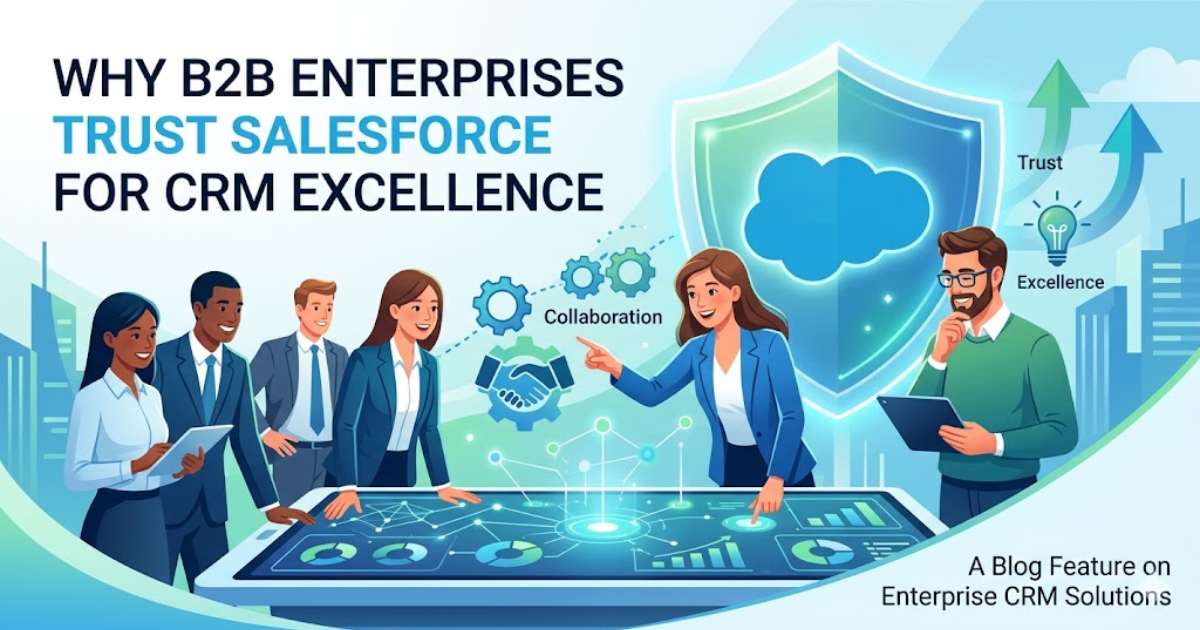
Against this backdrop, Salesforce has established itself as a preferred CRM platform for B2B enterprises. Its adoption spans industries such as manufacturing, SaaS, logistics, and financial services. This article explains the reasons behind that trust, focusing on architecture, scalability, integration capabilities, and measurable business outcomes.
The Complexity of B2B Customer Relationships
B2B transactions differ significantly from B2C interactions. A single deal often involves:
- Multiple decision-makers
- Longer sales cycles
- Contract negotiations and compliance requirements
- Post-sale relationship management
Traditional systems struggle to manage these layers effectively. B2B enterprises require a centralized platform that provides visibility across the entire customer lifecycle. Salesforce addresses this requirement with a unified data model and modular cloud ecosystem.
Unified Platform Architecture
One of the primary reasons enterprises rely on Salesforce is its multi-tenant cloud architecture. This design ensures that all users operate on a shared infrastructure while maintaining strict data isolation.
Key Architectural Advantages
- Centralized Data Model: Sales, marketing, and service teams access the same customer records.
- Real-Time Updates: Changes reflect instantly across departments.
- High Availability: The platform maintains strong uptime records suitable for enterprise operations.
This architecture reduces data silos, which often cause inefficiencies in B2B organizations.
Customization Through Salesforce Development
Every B2B enterprise operates with unique workflows. Off-the-shelf CRM systems often fall short in addressing these requirements. This is where a Salesforce Development Company plays a critical role.
Role of Custom Development
A specialized development partner can:
- Build custom objects and workflows tailored to business processes
- Design role-based dashboards for different teams
- Implement automation for repetitive tasks
- Extend functionality using Apex and Lightning components
Organizations that invest in Salesforce Development Services gain a system aligned with their operational model rather than forcing teams to adapt to rigid software.
Advanced Analytics and Data-Driven Decisions
Data plays a central role in B2B decision-making. Salesforce integrates analytics tools that help enterprises interpret large datasets.
Capabilities That Support Decision-Making
- Pipeline forecasting with historical trend analysis
- Customer segmentation based on behavior and engagement
- Performance tracking across sales teams
By combining structured CRM data with predictive insights, businesses can make informed decisions rather than relying on assumptions.
Integration with Enterprise Ecosystems
B2B organizations rarely operate with a single system. They rely on ERP platforms, marketing automation tools, and supply chain systems.
Salesforce supports integration through APIs and middleware solutions.
Common Integrations
- ERP systems such as SAP or Oracle
- Marketing platforms for campaign management
- Customer support tools and ticketing systems
These integrations create a connected ecosystem where data flows seamlessly across departments.
Automation Across the Sales Lifecycle
Automation plays a key role in improving operational efficiency. In B2B environments, repetitive tasks consume valuable time that sales teams could otherwise spend on relationship-building.
Areas Where Automation Helps
- Lead assignment and routing
- Follow-up reminders and notifications
- Quote generation and approval workflows
Automation reduces manual effort while maintaining consistency in processes.
Scalability for Growing Enterprises
Growth presents challenges such as increased data volume, additional users, and more complex workflows. Salesforce supports scalability without requiring major infrastructure changes.
Scalability Features
- Flexible licensing models
- Modular cloud offerings (Sales Cloud, Service Cloud, etc.)
- Support for global teams with multi-currency and multi-language capabilities
This flexibility allows enterprises to expand operations without replacing their CRM system.
Security and Compliance
B2B enterprises often handle sensitive customer and financial data. Security remains a top priority.
Salesforce includes:
- Role-based access controls
- Data encryption at rest and in transit
- Compliance with standards such as GDPR and ISO certifications
These features help organizations meet regulatory requirements while maintaining data integrity.
Real-World Case Example: Manufacturing Enterprise
A global manufacturing company faced challenges managing distributor relationships across multiple regions. Their legacy CRM system lacked integration with supply chain data, which caused delays in order processing and limited visibility into customer interactions.
After implementing Salesforce with the support of a Salesforce Development Company, the organization achieved:
- Centralized tracking of distributor activities
- Real-time synchronization with inventory systems
- Improved communication between regional sales teams
The company also adopted Salesforce Development Services to create custom dashboards for regional managers. These dashboards provided insights into sales performance, order status, and customer engagement.
As a result, the organization improved operational coordination and reduced response times for customer inquiries.
ROI and Business Impact
Investments in CRM systems must demonstrate measurable returns. B2B enterprises using Salesforce often report tangible benefits.
Measurable Outcomes
- Sales Productivity: Increased by 15–20% (source: McKinsey & Company)
- Customer Retention: Improved due to better relationship tracking
- Operational Efficiency: Reduced manual workload through automation
- Faster Deal Closures: Enhanced visibility into pipeline stages
Cost Considerations
While implementation requires investment, long-term gains often outweigh initial costs. Customization through Salesforce Development Services ensures that businesses maximize value from the platform.
Continuous Innovation and Ecosystem
Salesforce continues to evolve with new features, including AI-driven insights and industry-specific solutions. Its ecosystem includes thousands of third-party applications available through its marketplace.
This ongoing development ensures that enterprises can adapt to changing business environments without migrating to new systems.
Final Thoughts
B2B enterprises operate in complex environments where customer relationships drive long-term revenue. A CRM platform must support these relationships with reliability, flexibility, and actionable insights.
Salesforce meets these requirements through its unified architecture, customization capabilities, integration support, and scalability. Organizations that engage a Salesforce Development Company and invest in Salesforce Development Services can tailor the platform to their exact needs, ensuring alignment with business goals.
As data continues to shape decision-making, CRM systems will remain central to enterprise strategy. Platforms that combine technical robustness with adaptability will continue to earn the trust of B2B organizations.

Casey Morgan is a Digital Marketing Manager with over 10 years of experience in developing and executing effective marketing strategies, managing online campaigns, and driving brand growth. she has successfully led marketing teams, implemented innovative digital solutions, and enhanced customer engagement across various platforms.