












































The Internet of Things (IoT) has moved beyond pilot projects and proof-of-concept deployments. In 2026, enterprises across manufacturing, logistics, healthcare, energy, automotive, and infrastructure are investing in connected systems that generate operational visibility, reduce equipment downtime, and support data-driven decision-making. IoT is no longer treated as an innovation experiment. It now serves as a core operational layer for modern business.
Recent industry data reinforces this shift. Statista estimates that global IoT-connected devices will surpass 29 billion by 2030, nearly doubling from current levels. McKinsey & Company projects IoT could contribute $5.5 trillion to $12.6 trillion in annual economic value by 2030, with manufacturing, smart cities, and supply chain applications leading adoption. At the same time, Gartner reports that security concerns, device interoperability, and deployment scalability remain the three biggest enterprise barriers in IoT adoption.
This is exactly why choosing the right IoT development company matters.
Businesses need more than application developers. They need engineering partners that understand firmware architecture, hardware integration, edge computing, secure cloud connectivity, analytics infrastructure, and long-term device lifecycle management. A capable iot solution provider helps organizations build IoT ecosystems that scale reliably while protecting operational data and infrastructure.
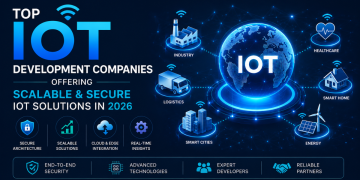
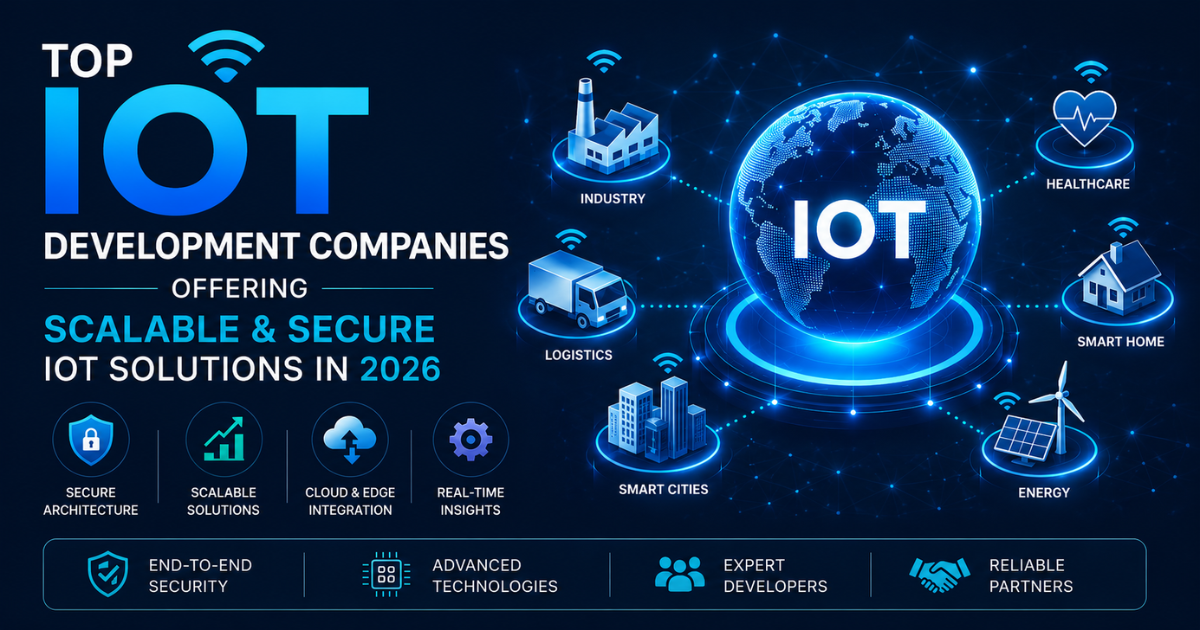
This article examines the top IoT development companies offering scalable and secure IoT solutions in 2026, with a close look at their engineering capabilities, industry strengths, and business fit.
What Makes a Strong IoT Development Company?
Selecting an IoT partner requires deeper technical evaluation than traditional software outsourcing.
A reliable IoT development company should demonstrate strength across the following areas:
1) Embedded Engineering Expertise
Connected systems begin at device level. Companies should have experience in:
- Firmware development
- RTOS implementation
- MCU programming
- Sensor calibration
- Gateway development
- Device communication protocols
Without embedded engineering depth, IoT systems often remain dependent on third-party hardware limitations.
2) Connectivity and Protocol Knowledge
Enterprise IoT rarely runs on a single communication standard. Strong vendors understand:
- MQTT
- Modbus
- CAN Bus
- BLE
- Zigbee
- LoRaWAN
- NB-IoT
- Wi-Fi 6
- Cellular IoT networks
Protocol flexibility often determines deployment success.
3) Security Engineering
IoT security cannot be treated as an afterthought.
Key requirements include:
- Device authentication
- Secure boot processes
- Firmware signing
- OTA update security
- Encryption in transit and at rest
- Access control management
- Device certificate lifecycle management
A mature iot solution provider builds security into architecture from day one.
4) Cloud and Edge Architecture
IoT produces large volumes of data. Not all of it should move directly to cloud systems.
Efficient vendors design:
- Edge filtering systems
- Local event processing
- Hybrid cloud-edge infrastructure
- Low-latency analytics
- Centralized fleet dashboards
This reduces bandwidth costs and improves real-time responsiveness.
Top IoT Development Companies in 2026
1) Softeq
Softeq has developed a strong reputation for complex IoT engineering programs where hardware and software must work as one tightly integrated system. The company focuses heavily on connected product development, industrial automation systems, smart consumer electronics, and medical IoT solutions.
What separates Softeq from many software-focused vendors is its product engineering depth. Their teams work on firmware, PCB-level hardware integration, edge software, cloud platforms, and companion applications under one engineering model.
Core strengths
- Embedded firmware architecture
- Secure gateway engineering
- Edge AI implementation
- Hardware prototyping
- OTA firmware deployment systems
- Industrial analytics dashboards
Industries served
- Manufacturing
- MedTech
- Consumer electronics
- Automotive
- Logistics
Best fit
Organizations building custom connected products from ground up.
Softeq remains a strong IoT development company because it understands product lifecycle engineering, not just software delivery.
2) Intuz
Intuz has built its IoT practice around scalable cloud-connected ecosystems and faster go-to-market deployment models. Businesses that need connected platforms without lengthy product engineering cycles often choose Intuz because of its practical architecture approach.
Its engineering teams work extensively on IoT middleware, device management platforms, remote monitoring dashboards, and mobile integrations.
Technical capabilities
- AWS IoT architecture
- Azure IoT implementation
- Device fleet monitoring
- Predictive analytics models
- Remote diagnostics platforms
- API-based ecosystem integration
Industries served
- Healthcare
- Smart retail
- Logistics
- Home automation
- Connected mobility
Why it stands out
Intuz balances engineering quality with deployment speed, making it a practical iot solution provider for mid-market enterprises.
3) HashStudioz
HashStudioz has steadily built its position in IoT by focusing on industrial-grade engineering, embedded software development, and connected enterprise systems. Rather than limiting its work to dashboard development or cloud integration, the company operates across the complete IoT stack—from firmware to analytics.
This full-stack engineering capability makes HashStudioz particularly relevant for businesses building scalable industrial IoT ecosystems.
Its teams have experience across:
- BLE communication systems
- Zigbee mesh networks
- LoRaWAN deployment models
- Modbus industrial communication
- MQTT device messaging architecture
- NB-IoT connectivity
- Edge gateway computing
- Sensor-to-cloud pipelines
Core engineering strengths
- Embedded firmware development
- Device communication stack design
- Industrial automation platforms
- Real-time telemetry dashboards
- AI-based predictive maintenance systems
- Secure OTA update frameworks
- Device lifecycle monitoring
Industries served
- Smart manufacturing
- Fleet management
- Energy monitoring
- Healthcare devices
- Smart infrastructure
- Asset tracking systems
Best fit
Mid-sized and enterprise organizations requiring custom connected ecosystems rather than plug-and-play IoT products.
What makes HashStudioz notable in 2026 is its practical engineering orientation. It works on operational systems built for deployment, scale, and long-term maintainability—key characteristics businesses expect from a mature IoT development company.
4) HQSoftware
HQSoftware has established itself as a strong engineering partner for industrial IoT and enterprise automation projects. Its work often focuses on measurable operational efficiency rather than experimental innovation.
Key capabilities
- Industrial sensor network deployment
- Predictive maintenance systems
- Digital twin modeling
- SCADA data integration
- Machine analytics dashboards
- Asset monitoring systems
Industries
- Heavy manufacturing
- Industrial automation
- Utilities
- Mining
- Warehousing
Its engineering focus makes it a dependable iot solution provider for industrial modernization.
5) Chetu
Chetu specializes in enterprise-connected platforms that integrate IoT with existing operational software. This matters because many organizations struggle more with integration than device deployment.
Core strengths
- ERP + IoT integration
- CRM-connected device ecosystems
- Healthcare connected systems
- Logistics visibility platforms
- Inventory intelligence systems
Why companies choose Chetu
Strong enterprise integration capabilities combined with scalable cloud architecture.
6) ScienceSoft
ScienceSoft is widely recognized for security-first engineering. For regulated industries, this matters significantly.
Strengths
- Zero-trust architecture
- Secure firmware pipelines
- Device authentication systems
- Compliance-driven architecture
- Healthcare-grade security engineering
This makes ScienceSoft a trusted iot solution provider where security carries operational risk.
7) Oxagile
Oxagile combines IoT engineering with advanced analytics and video intelligence.
Ideal use cases
- Smart surveillance
- Intelligent city systems
- Video-enabled monitoring
- AI-powered operational analytics
Their niche specialization gives them a distinct place in enterprise IoT.
8) LeewayHertz
LeewayHertz focuses on advanced IoT ecosystems that combine:
- blockchain-based device trust
- AI-driven analytics
- enterprise cloud infrastructure
- secure connected automation
Their work suits innovation-heavy enterprises.
9) Bacancy
Bacancy offers scalable engineering with practical commercial flexibility.
Best suited for
- Startups
- Mid-sized manufacturers
- Connected SaaS platforms
- Rapid MVP-to-scale IoT programs
A practical IoT development company for budget-conscious deployment.
10) Itransition
Itransition stands out in backend-heavy IoT deployments involving high-volume device ecosystems.
Strengths
- Data engineering
- IoT analytics pipelines
- Fleet intelligence systems
- Enterprise architecture scaling
Their strength lies in infrastructure robustness.
Real Industrial Example
A global manufacturer deployed predictive IoT monitoring across 1,500 industrial assets.
Results:
- 37% reduction in downtime
- 24% lower maintenance spending
- 18% energy savings
- 31% faster incident response
These are measurable business outcomes—not theoretical gains.
Business ROI
Companies investing in mature IoT programs often report:
- 20–40% operational cost reduction
- 25–35% asset utilization improvement
- 30% faster maintenance cycles
- Significant visibility across distributed operations
That is why selecting the right IoT development company is a strategic decision, not simply a vendor choice.
Final Thoughts
IoT in 2026 is about operational scale, infrastructure security, and engineering reliability. Businesses need partners that understand connected architecture from device firmware to cloud analytics, while maintaining strong security standards across every layer of deployment.
The companies listed above represent organizations capable of building scalable connected systems that support long-term enterprise value. A capable iot solution provider does more than connect devices. It helps businesses improve operational visibility, reduce downtime, strengthen decision-making, and build IoT ecosystems designed for sustained growth.
This version keeps it neutral, editorial, and professional, while avoiding a direct mention of any single company in the conclusion.

Casey Morgan is a Digital Marketing Manager with over 10 years of experience in developing and executing effective marketing strategies, managing online campaigns, and driving brand growth. she has successfully led marketing teams, implemented innovative digital solutions, and enhanced customer engagement across various platforms.