











































Sales teams make decisions based on numbers every day. How many leads entered the pipeline? Which opportunities are most likely to close? Are sales representatives meeting their targets? Which regions are performing well?
The problem is that these answers are often scattered across different spreadsheets, CRM records, emails, dashboards, and reporting tools. When teams work with different versions of the same data, even a simple sales meeting can turn into a debate about whose numbers are correct.
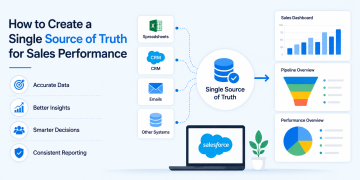
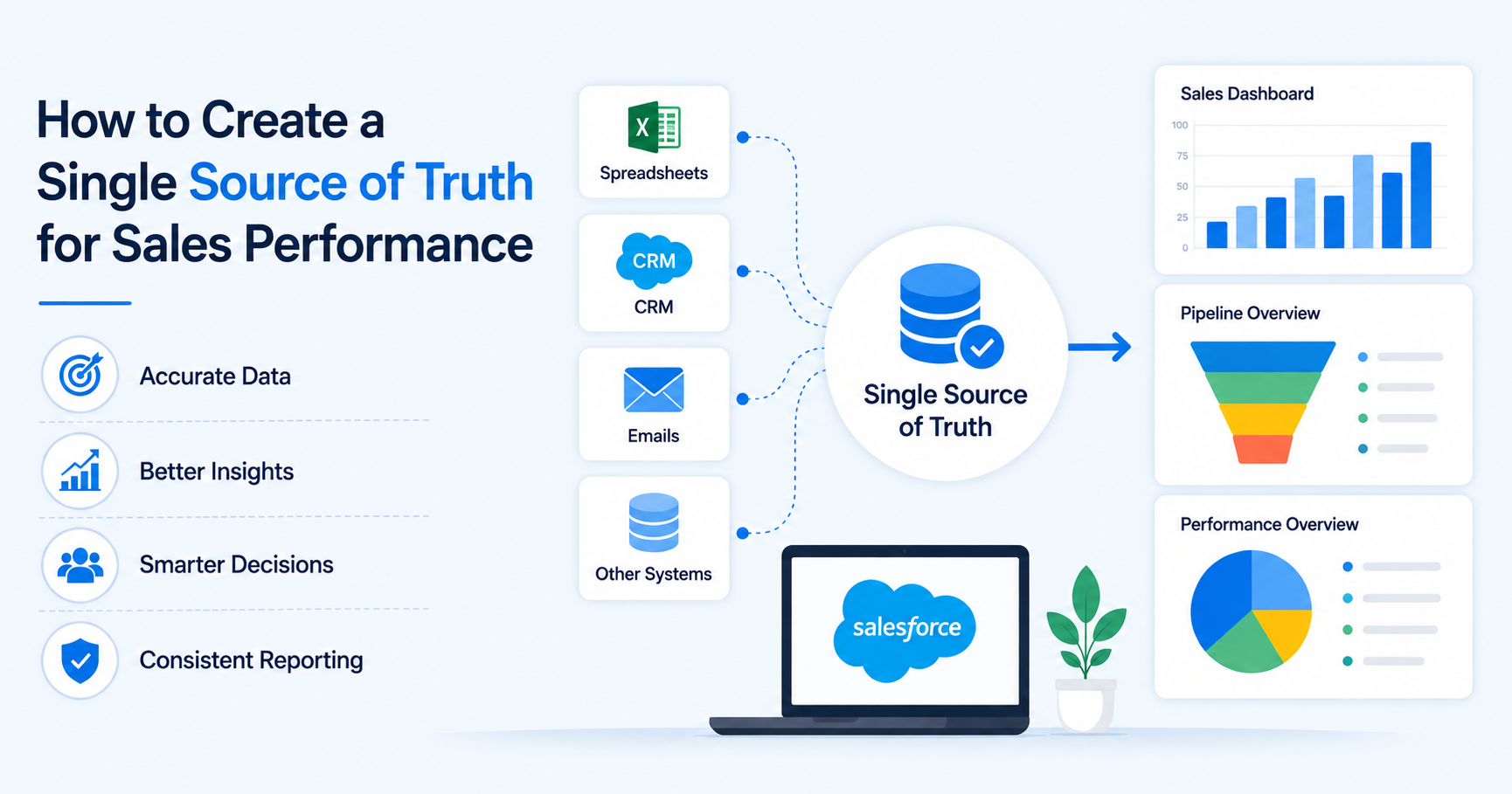
A single source of truth solves this problem by creating one trusted view of sales information across the organization. It gives sales leaders, managers, executives, and representatives a consistent understanding of performance and provides a reliable foundation for sales reporting and decision-making.
Building this system, however, requires more than creating another dashboard. Businesses need consistent data, clearly defined metrics, connected systems, and processes that keep information accurate over time.
What Does a Single Source of Truth Mean for Sales?
A single source of truth is a centralized and trusted source where sales data is collected, maintained, and reported using consistent definitions.
For a sales organization, this could include information about leads, accounts, opportunities, activities, revenue, sales targets, pipeline stages, win rates, and forecasts.
The important part is not simply keeping everything in one system. The data must also follow common rules.
For example, imagine two sales managers reporting pipeline value. One includes only qualified opportunities, while another includes every open lead. Both reports may be technically correct based on their own definitions, but the numbers cannot be compared meaningfully.
A reliable sales data environment establishes one definition for each important metric and applies it consistently.
This gives teams confidence that when they discuss pipeline, revenue, conversion rates, or sales performance, everyone is looking at the same information.
Why Sales Teams End Up With Conflicting Numbers
Sales data rarely becomes fragmented overnight. It usually happens as a company grows.
A small sales team may initially manage opportunities in spreadsheets. Later, the company introduces a CRM, marketing automation platform, customer support system, or separate reporting tool. Different teams may then create their own reports to answer specific questions.
Over time, several versions of the same information can appear.
A sales representative may maintain a personal spreadsheet. The sales manager may use a CRM report. Finance may use invoiced revenue. Senior management may rely on a business intelligence dashboard.
Each source may contain useful information, but the differences create confusion.
Common causes include:
- Duplicate customer records
- Inconsistent opportunity stages
- Different definitions of revenue
- Missing sales activities
- Manual spreadsheet updates
- Delayed data synchronization
- Different reporting periods
- Incorrect or incomplete CRM records
- Disconnected sales and marketing systems
When these issues continue, sales leaders spend more time validating data and less time acting on it.
Start by Defining What Sales Performance Actually Means
Before building dashboards or changing systems, businesses should decide which questions their sales data needs to answer.
Different organizations measure performance differently. A SaaS company may focus heavily on recurring revenue, customer acquisition cost, and pipeline coverage. A professional services company may care more about deal value, utilization, proposal conversion, and sales cycle length.
There is no universal list of sales metrics.
The first step is to identify the measures that directly support business decisions.
These may include:
- Pipeline value
- Revenue generated
- Win rate
- Conversion rate
- Average deal size
- Sales cycle length
- Pipeline coverage
- Quota attainment
- Forecast accuracy
- Lead-to-opportunity conversion
- Opportunity-to-customer conversion
Once these metrics are defined, the organization can determine what data is required to calculate them correctly.
This prevents a common mistake: building attractive dashboards before deciding what the numbers actually mean.
Create Consistent Definitions Across the Organization
One of the most important parts of creating a single source of truth is establishing a common data language.
Terms such as “qualified lead,” “active opportunity,” “closed deal,” and “revenue” should have clear definitions.
For example, an organization might define a qualified opportunity as a prospect that has confirmed a business need, identified an appropriate decision-maker, and reached a specific stage in the sales process.
Once that definition is established, it should be applied across teams and reports.
The same principle applies to revenue. Sales may report booked revenue, while finance reports recognized revenue. Both measures can be useful, but they should not be presented as though they represent the same thing.
Clear definitions prevent teams from comparing numbers that were never intended to measure the same outcome.
Make the CRM the Foundation of Sales Data
For many organizations, the CRM can serve as the central system for customer and sales information.
Instead of allowing sales representatives to maintain critical information across multiple spreadsheets, businesses can establish the CRM as the primary location for accounts, contacts, leads, opportunities, activities, and sales stages.
This does not mean every piece of business information needs to live inside the CRM.
Other systems may remain important for finance, marketing, customer service, or operations. The goal is to establish which system owns each type of data and how information moves between systems.
For Salesforce users, this often means carefully structuring objects, fields, opportunity stages, ownership rules, validation requirements, and reporting logic before building advanced Salesforce dashboards.
A well-designed foundation makes reporting much more reliable.
Connect the Systems That Sales Teams Depend On
A CRM cannot provide a complete picture if important information remains disconnected.
Sales teams may rely on marketing automation platforms, customer support applications, billing systems, e-commerce platforms, communication tools, or data warehouses.
Consider a simple customer journey.
Marketing generates a lead. Sales qualifies it and creates an opportunity. The customer signs a contract. Finance processes the invoice. Customer support handles the account after purchase.
If these systems do not communicate properly, sales leaders may see only part of the customer journey.
Integrating relevant systems can help create a more complete picture while reducing repetitive data entry.
However, integration should not mean connecting every system simply because it is technically possible. Businesses should identify which information needs to move between systems and which system should remain the authoritative source for that information.
Improve Data Quality at the Point of Entry
Dashboards can only be as reliable as the data behind them.
If sales representatives enter incomplete or inconsistent information, even the best reporting architecture will produce questionable results.
This is why data quality should be managed during data entry rather than fixed at the reporting stage.
Businesses can improve data quality through:
- Required fields
- Validation rules
- Standardized picklists
- Duplicate detection
- Automated workflows
- Clear sales stage definitions
- Data ownership rules
- Regular data audits
For example, if an opportunity cannot move to the proposal stage without an expected close date and deal value, the CRM can prevent incomplete records from entering the next stage.
Small controls like these can significantly improve reporting quality over time.
Build Salesforce Dashboards Around Business Questions
A dashboard should help someone make a decision.
It should not exist simply because the CRM can display charts and graphs.
Effective Salesforce dashboards should answer specific business questions.
A sales representative might need to know:
- Which opportunities require attention?
- Which deals are approaching their expected close date?
- How much pipeline do I have?
- Am I on track to meet my target?
A sales manager may need a different view:
- Which representatives are behind the target?
- Where is pipeline coverage weak?
- Which opportunities have stalled?
- How accurate are current forecasts?
An executive may care about:
- Revenue performance
- Regional performance
- Pipeline health
- Forecast trends
- New business growth
- Customer acquisition
Trying to put every metric on one dashboard usually creates more noise than insight.
A better approach is to create role-specific views while ensuring that every dashboard uses the same underlying data and metric definitions.
Separate Operational Reports From Executive Reporting
Not every sales report needs to serve the same purpose.
Operational reports help teams manage daily activities. Management reports help sales leaders identify trends and performance gaps. Executive dashboards provide a high-level view of business health.
Keeping these purposes separate makes reporting easier to understand.
For example, a sales representative may need a detailed list of opportunities that have not been updated recently. A chief revenue officer does not need that level of detail. They may need pipeline value, forecast accuracy, revenue attainment, and trend information.
The data can come from the same trusted source while the presentation changes based on the audience.
Automate Sales Reporting Wherever Possible
Manual reporting creates unnecessary work and increases the risk of errors.
If sales managers spend hours every week exporting CRM data, cleaning spreadsheets, and combining information from different systems, the reporting process itself becomes a business problem.
Automation can help reduce this burden.
Sales teams can automate activities such as:
- Scheduled reports
- Dashboard refreshes
- Pipeline alerts
- Data validation
- Duplicate detection
- Forecast updates
- Performance notifications
- Data synchronization
Automation also allows managers to spend more time interpreting results instead of preparing them.
However, automation should be introduced only after the underlying data and processes are stable. Automating a poorly defined process simply makes the wrong process run faster.
Establish Data Governance for Long-Term Accuracy
Creating a single source of truth is not a one-time project.
Sales processes change. New products are introduced. Teams grow. Territories change. CRM fields are added. Reporting requirements evolve.
Without governance, data quality can gradually decline.
A basic sales data governance process should define:
- Who owns the data?
Someone should be responsible for maintaining important fields and processes. - Who can change reporting definitions?
Metric definitions should not change casually from one quarter to another. - How often is data reviewed?
Regular audits can identify duplicates, missing information, and outdated records. - How are changes documented?
Teams should understand why fields, workflows, or metrics have changed.
Governance creates accountability and helps preserve consistency as the organization grows.
Use Sales Reporting to Drive Better Decisions
The purpose of centralized sales data is not to create more reports.
It is to improve decision-making.
Suppose a dashboard shows that one region has strong pipeline growth but low conversion rates. The sales leader can investigate whether lead quality, pricing, sales skills, or market conditions are affecting performance.
Another dashboard may show that opportunities are spending unusually long periods in one stage. That could indicate a problem with qualification, approvals, pricing, or customer engagement.
Good reporting raises questions that lead to action.
This is why sales reporting should focus on trends, exceptions, and business outcomes rather than simply displaying large amounts of data.
Where Sales Cloud Consulting Can Add Value
Businesses often have the technology needed to create a single source of truth but struggle to bring everything together.
This is where Sales Cloud consulting can be useful.
An experienced consulting team can help organizations review their existing sales processes, CRM configuration, data model, reporting requirements, integrations, and automation opportunities.
The work may involve redesigning opportunity stages, cleaning existing data, defining reporting standards, building dashboards, improving workflows, or connecting Salesforce with other business systems.
The most valuable part is often not the dashboard itself. It is making sure the organization agrees on what the dashboard should measure and where that information should come from.
A consulting-led approach can also help identify unnecessary complexity. Not every metric needs a custom report, and not every process needs automation.
The goal should be a reporting environment that sales teams can trust and actually use.
A Practical Roadmap to Build a Single Source of Truth
Businesses can approach the process in stages rather than attempting to rebuild their entire reporting environment at once.
1. Audit Existing Sales Data
Identify where sales information currently lives and look for duplicate, outdated, or conflicting data.
2. Define Core Metrics
Agree on the metrics that matter most and establish clear definitions for each one.
3. Assign Data Ownership
Determine which system owns each type of information and who is responsible for maintaining it.
4. Standardize CRM Processes
Review fields, opportunity stages, validation rules, workflows, and user permissions.
5. Connect Relevant Systems
Integrate the systems that provide important information for sales performance and reporting.
6. Build Role-Based Dashboards
Create dashboards for sales representatives, managers, and executives based on their decision-making needs.
7. Monitor and Improve
Review data quality and dashboard usage regularly. Update processes as business requirements change.
This gradual approach is often more practical than trying to solve every data problem at once.
Final Thoughts
A single source of truth gives sales teams something more valuable than another reporting tool: confidence in the numbers they use to make decisions.
When customer data, pipeline information, sales activities, revenue figures, and performance metrics follow consistent definitions, organizations can spend less time questioning reports and more time acting on what the data shows.
The foundation starts with clean data and clear processes. From there, connected systems, well-designed Salesforce dashboards, automated workflows, and reliable sales reporting can turn scattered information into useful business insight.
For organizations already using Salesforce, Sales Cloud consulting can help bring these elements together by aligning CRM processes, data structures, integrations, and reporting around the way the sales organization actually operates.
A true single source of truth is not just a dashboard. It is a company-wide agreement about where sales data comes from, what it means, and how it should be used.

Casey Morgan is a Digital Marketing Manager with over 10 years of experience in developing and executing effective marketing strategies, managing online campaigns, and driving brand growth. she has successfully led marketing teams, implemented innovative digital solutions, and enhanced customer engagement across various platforms.