











































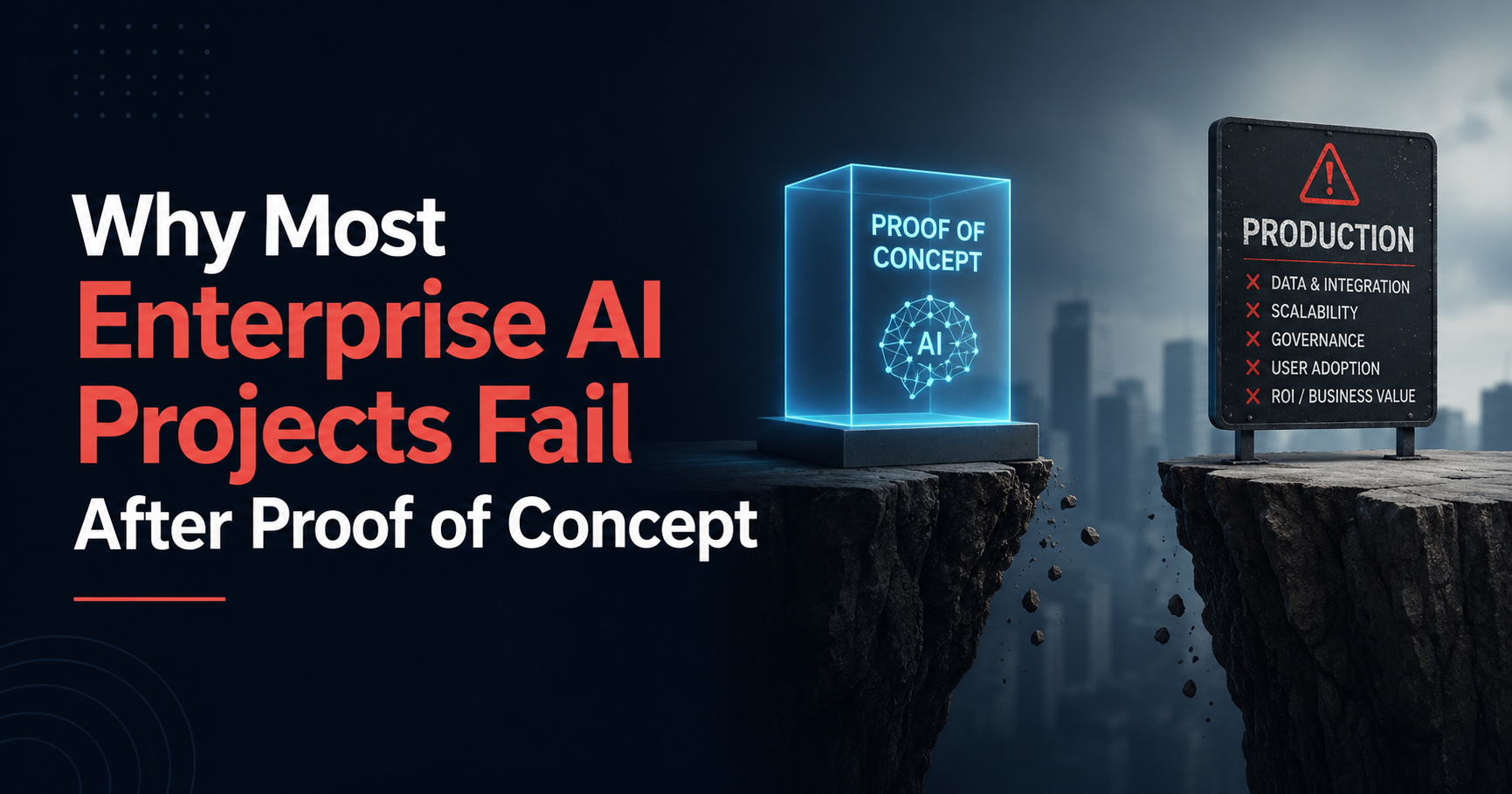
The corporate landscape is experiencing a rapid surge in artificial intelligence investment, yet a consistent gap persists between experimental success and production-scale impact. Many organizations successfully demonstrate working prototypes, but struggle to convert those prototypes into stable, revenue-generating systems.
Recent industry research highlights the scale of this issue. Reports from the MIT NANDA initiative suggest that a large majority of generative AI pilots fail to deliver measurable financial outcomes. Analyst commentary further indicates that while most enterprises experiment with AI in at least one function, only a fraction manage to scale it across multiple business units. Gartner has similarly observed that a significant portion of generative AI initiatives stall after the proof-of-concept stage due to foundational limitations such as poor data quality, unclear business value, and escalating operational complexity.
The core issue is not whether AI works. In controlled environments, it often performs well. The real challenge emerges when organizations attempt to transition from isolated experimentation to enterprise-wide deployment.
The Real Challenge Begins After the Prototype Works
Most AI initiatives do not fail because the model is incorrect or poorly designed. They fail because the environment changes dramatically after the proof-of-concept stage.
A prototype typically operates in a controlled setting with curated datasets, stable infrastructure, and narrowly defined objectives. This creates the illusion of simplicity. However, enterprise environments introduce entirely different conditions: continuous data streams, legacy systems, security constraints, and distributed workflows.
At this stage, organizations discover a critical gap. Building a model is relatively straightforward compared to embedding it into operational systems that must run reliably at scale.
Why Production AI Is a Different Engineering Problem
The transition from prototype to production introduces structural challenges that are often underestimated during early experimentation.
Data drift and fragmented systems
In controlled testing environments, models are trained on static datasets. Once deployed, they must operate on continuously evolving data. Customer behavior shifts, operational inputs change, and external conditions introduce variability. This phenomenon, often referred to as data drift, gradually reduces model accuracy.
At the same time, enterprise data is rarely centralized. Information is distributed across ERP systems, CRM platforms, cloud storage, and third-party applications. Connecting these systems requires robust APIs, strong data engineering practices, and continuous synchronization. Without this foundation, AI systems become unstable in real-world conditions.
Scale and infrastructure limitations
A system that performs well with limited usage may struggle significantly under enterprise-level demand. Processing a small number of requests is fundamentally different from handling thousands of concurrent operations across regions.
As usage scales, organizations encounter constraints in compute capacity, latency, and cost efficiency. In many cases, they must rely on specialized infrastructure such as GPUs or distributed cloud architectures. These requirements introduce both financial and operational complexity.
For industries such as manufacturing, logistics, and IoT-enabled environments, additional constraints emerge at the edge layer. Devices often have limited compute power, requiring model optimization techniques such as quantization or local inference execution.
The Hidden Cost Structure of Enterprise AI
One of the most underestimated aspects of AI deployment is cost distribution. Early-stage prototypes tend to obscure the true financial requirements of production systems.
During experimentation, costs are typically limited to model access and basic data preparation. However, production environments introduce continuous and recurring expenses that scale with usage.
These include:
- Real-time data pipelines and synchronization systems
- Vector storage and retrieval infrastructure
- High-availability compute environments
- Model monitoring and retraining cycles
- Security and compliance enforcement layers
Unlike prototype costs, these expenses do not remain static. They increase proportionally with system adoption and data volume.
Another important factor is inference cost. Every query, transaction, or generated output consumes compute resources. At enterprise scale, this can significantly impact operational budgets, especially for high-volume customer-facing applications.
Security, Compliance, and Risk Management
Moving an AI system into production introduces exposure to sensitive data and operational risk. This requires a shift from experimental flexibility to structured governance.
Organizations must implement safeguards such as:
- Data protection controls to prevent leakage of sensitive information
- Mechanisms to defend against prompt injection and adversarial inputs
- Monitoring systems to detect anomalous or unauthorized behavior
- Compliance alignment with regional data protection regulations
These requirements rarely influence prototype design but become essential in production environments. As a result, engineering teams must invest additional effort into building secure, auditable, and resilient architectures.
The Human Factor in AI Adoption
Technical performance alone does not determine success. Many AI initiatives fail because they do not integrate effectively into human workflows.
If a system introduces additional steps, disrupts existing processes, or requires users to switch between multiple tools, adoption declines rapidly. Employees tend to reject systems that increase friction, even if the underlying technology is accurate.
Successful implementations embed AI directly into operational workflows, allowing users to interact with insights without changing their core processes. This often determines whether a system becomes a daily operational tool or remains an unused experiment.
Organizational Capability Gaps
Another major barrier is the shortage of specialized operational expertise. Developing a working model is only one part of the challenge. Maintaining it in production requires continuous monitoring, version control, and performance optimization.
This discipline, often referred to as MLOps, is still maturing in many organizations. Without it, models degrade over time, systems break under load, and performance becomes inconsistent.
To address this gap, many enterprises collaborate with a Generative AI Development Company that provides architectural design, deployment frameworks, and operational support required for production-grade systems.
Case Study: Industrial Predictive Quality in Manufacturing
A global automotive components manufacturer provides a useful example of how these challenges manifest in practice.
The organization initially developed a predictive quality system using historical sensor data collected from production lines. In a controlled environment, the model performed well, identifying potential defects with high accuracy. The proof-of-concept was considered successful.
However, issues emerged during full-scale deployment.
Key challenges included:
- Delayed data ingestion: Legacy industrial systems could not stream sensor data in real time, leading to delayed predictions
- False positives: Environmental variability caused the model to misinterpret normal fluctuations as defects
- Low user trust: Operators found the system difficult to interpret and ignored alerts
As a result, the system failed to integrate into daily operations despite strong technical performance in testing.
Resolution approach
The organization re-engineered the system by:
- Introducing edge computing gateways for real-time data processing
- Expanding training datasets to include environmental variations
- Simplifying the user interface to deliver actionable, context-specific alerts
Once these changes were implemented, the system transitioned from an experimental tool into an operational asset that supported production decisions.
Measuring Real Business Impact
Evaluating AI success requires shifting focus from model accuracy to operational outcomes. In production environments, business value is determined by how effectively systems improve efficiency, reduce cost, and support decision-making.
Common performance indicators include:
- Reduction in manual processing effort
- Improvement in transaction efficiency and throughput
- Stability of model performance over time (drift resistance)
- Adoption rate within business workflows
- Infrastructure cost per operation
Across enterprise deployments, organizations that successfully scale AI typically observe meaningful improvements in operational efficiency and decision velocity. In many cases, the return on investment becomes visible within the first year of deployment, depending on system complexity and integration maturity.
Strategic Principles for Successful Scaling
Organizations that successfully move beyond the proof-of-concept stage tend to follow a consistent set of principles.
Design for production from the beginning
Production constraints such as latency, security, and scalability should be defined before development begins. Systems that ignore these constraints early often require complete redesign later.
Treat data as a foundational asset
Model performance depends heavily on data quality and accessibility. Building clean, modular, and well-governed data infrastructure is more important than frequent model iteration.
Focus on human-system alignment
AI systems must enhance existing workflows rather than disrupt them. Adoption increases significantly when users can access insights without changing established operational processes.
Final Thoughts
The gap between AI experimentation and production deployment is not primarily a technical limitation. It is an integration challenge that spans data architecture, infrastructure scaling, security design, and human adoption.
Most organizations underestimate this transition because prototype success creates a false sense of readiness. In reality, production AI requires a fundamentally different engineering discipline.
Enterprises that recognize this early and invest in scalable architecture, strong data foundations, and workflow-aligned design are far more likely to achieve sustained value from AI systems. Those that do not often remain stuck in a cycle of successful experiments that never translate into operational impact.
In enterprise AI, success is not defined by whether a model works in isolation, but by whether it continues to deliver value inside complex, real-world environments.

Casey Morgan is a Digital Marketing Manager with over 10 years of experience in developing and executing effective marketing strategies, managing online campaigns, and driving brand growth. she has successfully led marketing teams, implemented innovative digital solutions, and enhanced customer engagement across various platforms.