











































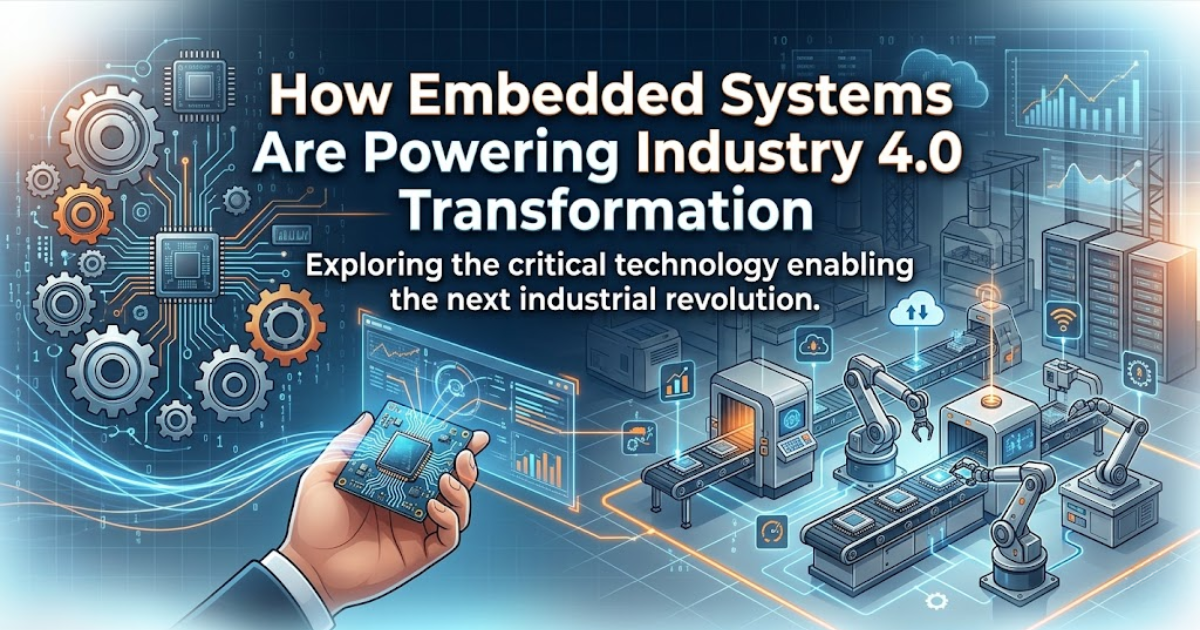
Embedded systems play a central role in Industry 4.0 by enabling machines to sense, process, and act on data in real time. They connect physical equipment with digital platforms, making industrial environments more responsive, data-driven, and efficient.
According to Statista, the global Industrial IoT market is projected to exceed $1 trillion by 2028, reflecting strong adoption of connected systems. McKinsey & Company reports that smart manufacturing technologies can improve productivity by up to 30%, while Gartner estimates that over 75% of industrial organizations will deploy IoT-enabled solutions at scale by 2026.
This shift depends heavily on embedded systems and robust Embedded Software Development practices that support real-time intelligence at the device level.
What Are Embedded Systems in Industry 4.0?
Embedded systems are dedicated computing units integrated into machines, sensors, and industrial devices. They perform specific tasks with high reliability and low latency.
In Industry 4.0 environments, these systems:
- Collect data from sensors
- Process information locally
- Trigger automated actions
- Communicate with cloud and enterprise platforms
Modern Embedded Software Development focuses on building efficient firmware and system-level applications that operate under strict performance and reliability constraints.
Why Embedded Systems Matter in Industrial Transformation
Industry 4.0 relies on continuous data exchange between machines, systems, and human operators. Embedded systems enable this interaction.
Key Reasons for Their Importance
- They provide real-time visibility into operations
- They support automation without human intervention
- They reduce dependency on centralized processing
- They enable predictive maintenance and analytics
Without embedded systems, industrial environments would lack the responsiveness required for modern manufacturing.
Real-Time Processing at the Edge
One of the defining characteristics of Industry 4.0 is the need for immediate decision-making. Sending all data to centralized servers creates delays.
Embedded systems solve this problem through edge computing.
Practical Advantages
- Faster response to operational changes
- Reduced network dependency
- Lower data transmission costs
For example, a machine equipped with embedded intelligence can detect overheating and shut down instantly, preventing damage.
An effective Embedded Software Development Solution ensures that these systems operate efficiently even in resource-constrained environments.
Integration with Industrial IoT (IIoT)
Embedded systems form the foundation of Industrial IoT networks. They enable communication between devices and enterprise systems.
Typical Integration Scenarios
- Sensor-to-cloud communication
- Machine-to-machine coordination
- Integration with ERP and analytics platforms
Embedded Software Development ensures compatibility with communication protocols such as MQTT and HTTP, allowing seamless data exchange.
Automation and Process Optimization
Automation is a key goal of Industry 4.0. Embedded systems enable machines to operate independently while maintaining accuracy.
Areas of Impact
- Automated assembly lines
- Quality inspection using embedded vision systems
- Real-time production monitoring
These systems reduce manual intervention and improve consistency across operations.
Predictive Maintenance and Asset Monitoring
Unplanned downtime remains one of the biggest challenges in industrial environments. Embedded systems help address this issue through continuous monitoring.
How It Works
- Sensors collect data on vibration, temperature, and usage
- Embedded systems analyze patterns locally
- Alerts trigger when anomalies are detected
This approach allows maintenance teams to act before failures occur, reducing downtime and repair costs.
Supporting Autonomous Industrial Systems
Industry 4.0 introduces autonomous machines that operate with minimal human input. Embedded systems enable these capabilities.
Examples
- Robotic manufacturing units
- Automated guided vehicles (AGVs)
- Smart warehouse systems
Each system relies on embedded software to process sensor data and execute actions in real time.
Security in Connected Environments
As industrial systems become more connected, security risks increase. Embedded systems must include strong protection mechanisms.
Key Security Measures
- Secure boot processes
- Data encryption
- Authentication and access control
A well-designed Embedded Software Development Solution incorporates these features at the system level, ensuring data integrity and operational safety.
Real-World Case Example: Siemens Smart Factory
A well-documented example of Industry 4.0 implementation is the smart manufacturing facility operated by Siemens in Amberg, Germany.
What They Implemented
- Embedded systems across production lines
- Real-time communication between machines
- Data-driven optimization of manufacturing processes
Results
- Production quality exceeding 99%
- Reduced manual intervention
- Improved efficiency through continuous monitoring
This example highlights how embedded systems support complex industrial operations at scale.
ROI and Business Impact
Organizations investing in embedded systems often see measurable improvements.
Key Outcomes
- Productivity Increase: Up to 30% (source: McKinsey & Company)
- Reduced Downtime: Predictive maintenance minimizes disruptions
- Cost Efficiency: Lower maintenance and operational costs
- Improved Product Quality: Greater precision in manufacturing
Financial Perspective
Although initial implementation requires investment, long-term savings and efficiency gains provide strong returns. Companies that adopt a structured Embedded Software Development approach often achieve faster ROI.
Challenges in Implementation
Despite their benefits, embedded systems present several challenges.
Common Issues
- Integration with legacy infrastructure
- Complexity in system design
- Security vulnerabilities
- Limited availability of skilled developers
Organizations must address these challenges through careful planning and robust engineering practices.
Future Trends in Embedded Systems
Embedded systems continue to evolve alongside Industry 4.0 technologies.
Emerging Developments
- Integration with artificial intelligence for advanced analytics
- Growth of low-power communication networks
- Increased focus on edge computing capabilities
- Enhanced security frameworks
These trends indicate that embedded systems will remain central to industrial innovation.
Final Thoughts
Embedded systems are not just a supporting component of Industry 4.0—they are a foundational technology that enables real-time intelligence, automation, and connectivity.
Businesses that invest in a reliable Embedded Software Development Solution and prioritize high-quality Embedded Software Development practices can build resilient and efficient industrial systems. These systems improve productivity, reduce downtime, and support long-term growth.
As Industry 4.0 continues to evolve, embedded systems will play an even greater role in shaping the future of manufacturing and industrial operations.

Casey Morgan is a Digital Marketing Manager with over 10 years of experience in developing and executing effective marketing strategies, managing online campaigns, and driving brand growth. she has successfully led marketing teams, implemented innovative digital solutions, and enhanced customer engagement across various platforms.