













































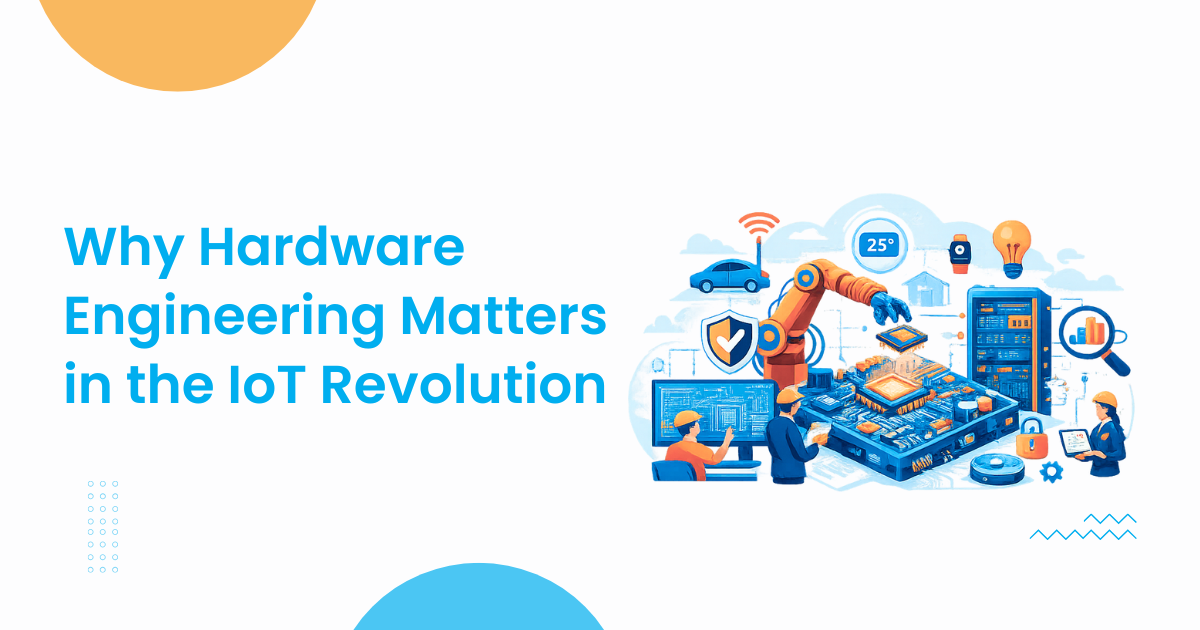
The Internet of Things (IoT) continues to transform industries at an unprecedented pace. In 2025, global IoT device installations reached an estimated 30 billion units, a figure projected to exceed 40 billion by 2030. These connected systems generate vast volumes of data and deliver actionable insights across sectors from manufacturing to healthcare. Yet, the success of IoT does not rest solely on wireless protocols or cloud platforms. Hardware engineering stands at the core of this global shift. It defines the performance, reliability, power efficiency, and security of connected systems.
In this article, we explore why hardware engineering matters in the IoT revolution. We focus on the technical aspects of physical design and how hardware integrates with software stacks, including embedded software development services and Embedded Software Development. These insights draw from engineering practice and real-world use cases.
What Is Hardware Engineering in IoT?
Hardware engineering refers to the design, testing, and implementation of physical components in electronic systems. In IoT devices, hardware includes sensors, microcontrollers, power systems, communication modules, and electronic circuits.
Key Hardware Components in IoT
- Sensors: Transducers that convert physical conditions into electrical signals.
- Microcontrollers: Low-power processors that run embedded code.
- Connectivity Modules: Components that communicate via Wi-Fi, Bluetooth, Zigbee, or cellular networks.
- Power Systems: Batteries, energy harvesting units, and power regulators.
- Circuit Boards: Printed circuit boards (PCBs) that interconnect components.
These components must work together with firmware and application layers. The integration between hardware and software determines an IoT device’s capabilities.
The Role of Hardware in System Performance
Performance in IoT systems depends on how well hardware can support computation, sensing, and communication.
Processing Power and Responsiveness
IoT devices often run real-time tasks. For example, an industrial sensor may trigger safety controls within milliseconds. Hardware engineers choose microcontrollers with the right balance of:
- Clock speed
- Memory capacity
- Peripheral support
Processors with insufficient power can cause delays in data acquisition or control response. Hardware design directly affects the responsiveness of IoT systems.
Power Efficiency
Most IoT endpoints run on limited power. Devices deployed in remote fields or inside infrastructure must operate for months without battery replacement. Hardware engineers reduce energy consumption by:
- Selecting ultra-low-power microcontrollers
- Using efficient power regulators
- Implementing sleep and wake cycles in firmware
These design choices are essential to prolong device lifetime and reduce maintenance costs.
Integration with Embedded Software Development Services
Hardware and software must interact seamlessly. Embedded software running on microcontrollers controls sensors, manages communication, and implements device logic.
Why Integration Matters
An IoT device with powerful hardware still fails if software cannot utilize its capabilities. Embedded software development services ensure that firmware aligns with hardware resources. These services include:
- Firmware writing and debugging
- Driver development for sensors and peripherals
- Real-time operating system (RTOS) integration
- Hardware abstraction layer development
Engineers in these services test software performance against timing constraints and hardware limitations. This collaboration ensures system stability and functionality.
Embedded Software Development Practices
Embedded software developers work closely with hardware engineers to:
- Map I/O pins correctly
- Optimize code for limited memory
- Implement efficient interrupt routines
- Manage power states to save energy
Without such practices, devices may behave unpredictably or drain energy too quickly.
Security by Design: Hardware’s Role
Security is paramount in IoT. Each connected endpoint can be a potential entry point for cyberattacks. Hardware engineering contributes to device security in several ways.
Hardware-Level Security Features
- Secure Boot: Verifies firmware integrity before execution.
- Trusted Execution Environment (TEE): Segregates critical code from general tasks.
- Hardware Encryption Engines: Accelerate cryptographic operations.
- Physical Unclonable Functions (PUFs): Provide hardware fingerprints for device identity.
These elements strengthen the device against cloning, tampering, and unauthorized access. Firmware alone cannot deliver these protections. Hardware design must enable them.
Hardware Testing for Security
Security testing must include hardware probes, bus monitoring, and fault injection tests. Hardware engineers work with security analysts to:
- Validate tamper resistance
- Assess side-channel leakage
- Ensure secure key storage
This combined effort ensures a strong security posture in deployed systems.
Reliability and Environmental Considerations
IoT devices operate in diverse environments, from factories to outdoor weather stations. Hardware engineers design systems that remain reliable under stress.
Environmental Constraints
Hardware must endure:
- Extreme temperatures
- Dust and moisture
- Mechanical vibration
- Electromagnetic interference
Engineers select components with appropriate ratings (e.g., industrial or automotive grade). They also design enclosures that protect electronics without blocking communication signals.
Testing for Reliability
Reliability tests include:
- Thermal cycling
- Humidity exposure
- Shock and vibration testing
- Long-term power cycling
Testing ensures devices function over expected lifetimes. These tests inform design decisions and component selections.
Communication and Network Interfaces
Connectivity lies at the heart of IoT. Hardware design influences communication range, bandwidth, and energy use.
Choosing Communication Technologies
Hardware engineers evaluate options based on application needs:
- Wi-Fi for high throughput at short range
- Bluetooth Low Energy (BLE) for personal area networks
- LoRaWAN for long-range, low-power communication
- Cellular (LTE/5G) for wide-area coverage
Each technology has trade-offs in power, cost, and complexity.
Antenna Design
Antenna quality significantly affects wireless performance. Engineers design antennas considering:
- Frequency bands
- Device form factor
- Proximity to other components
Poor antenna design leads to signal loss, dropped packets, and reduced range.
Manufacturing and Scalability
Hardware engineering also covers production and scalability.
Design for Manufacturing (DFM)
Engineers ensure that designs are manufacturable at scale. DFM practices reduce waste and lower costs. Considerations include:
- Simplified soldering processes
- Standardized component packages
- Tolerance analysis for PCB fabrication
These factors influence yield and long-term production reliability.
Testing at Scale
Test strategies escalate when moving from prototype to production. Automated test fixtures validate:
- Power consumption
- Communication interfaces
- Sensor calibration
- Firmware installation
A robust test plan helps catch defects before shipping.
Case Study: Industrial IoT Devices
Industrial IoT (IIoT) systems monitor processes and optimize operations. In a manufacturing plant, sensors track machine vibration. Hardware engineers ensure that these devices:
- Capture accurate accelerometer data
- Withstand high temperatures
- Connect securely to edge gateways
Embedded Software Development teams tune firmware to process sensor signals and report relevant metrics. The collaboration between hardware and software ensures uptime and worker safety.
The Future of IoT Hardware Engineering
Innovation in hardware will shape future IoT capabilities. Trends include:
- Edge computing chips that handle AI tasks locally
- Advanced sensors with self-calibration
- Energy harvesting to minimize power constraints
- Modular hardware platforms for rapid iteration
Engineers will need deeper cross-disciplinary skills in electronics, firmware, wireless protocols, and data analysis.
Conclusion
The push toward a fully connected world places hardware engineering at the forefront of the IoT revolution. Device performance, power efficiency, security, and reliability all hinge on sound hardware design. Embedded software development services and Embedded Software Development practices form the bridge between physical systems and application logic.
Organizations that focus on robust hardware engineering gain durable, secure, and efficient IoT solutions. Without strong hardware foundations, even the most sophisticated software cannot deliver meaningful value.
FAQs
- What is hardware engineering in IoT?
Hardware engineering in IoT focuses on designing and building the physical electronic parts of connected devices. - Why does power management matter in IoT hardware?
Power management prolongs device lifetime and reduces maintenance, especially in battery-powered systems. - How do embedded software development services relate to hardware?
These services write and test firmware that runs on hardware, ensuring proper device control and performance. - Can hardware improve IoT security?
Yes. Hardware features like secure boot and encryption engines enhance protection against attacks. - What factors influence wireless performance in IoT?
Component selection, antenna design, and chosen communication protocol all affect wireless outcomes.

Casey Morgan is a Digital Marketing Manager with over 10 years of experience in developing and executing effective marketing strategies, managing online campaigns, and driving brand growth. she has successfully led marketing teams, implemented innovative digital solutions, and enhanced customer engagement across various platforms.