








































Industrial IoT (IIoT) provides a double-edged sword: unprecedented visibility and unmanageable volume. As global IT spending is projected to reach $6.15 trillion in 2026—a 10.8% increase from 2025—a significant portion of that capital is flowing into data center systems and software designed to handle the massive influx of sensor data. However, the sheer quantity of data often outpaces the ability to analyze it. Research from IBM indicates that 90% of industrial data collected today goes completely unused. For any IoT Development Company, the mission has shifted from simply “connecting things” to architecting systems that filter noise and prioritize actionable intelligence.
Recent studies suggest that by the end of 2025, nearly 75% of enterprise data will be created and processed at the edge rather than in a centralized cloud. This shift is a direct response to the “Data Overload” crisis. Without robust management, manufacturers risk drowning in “data swamps” where valuable insights regarding machine health or energy efficiency are buried under terabytes of irrelevant status pings.
The Architecture of Intelligence: A Layered Approach
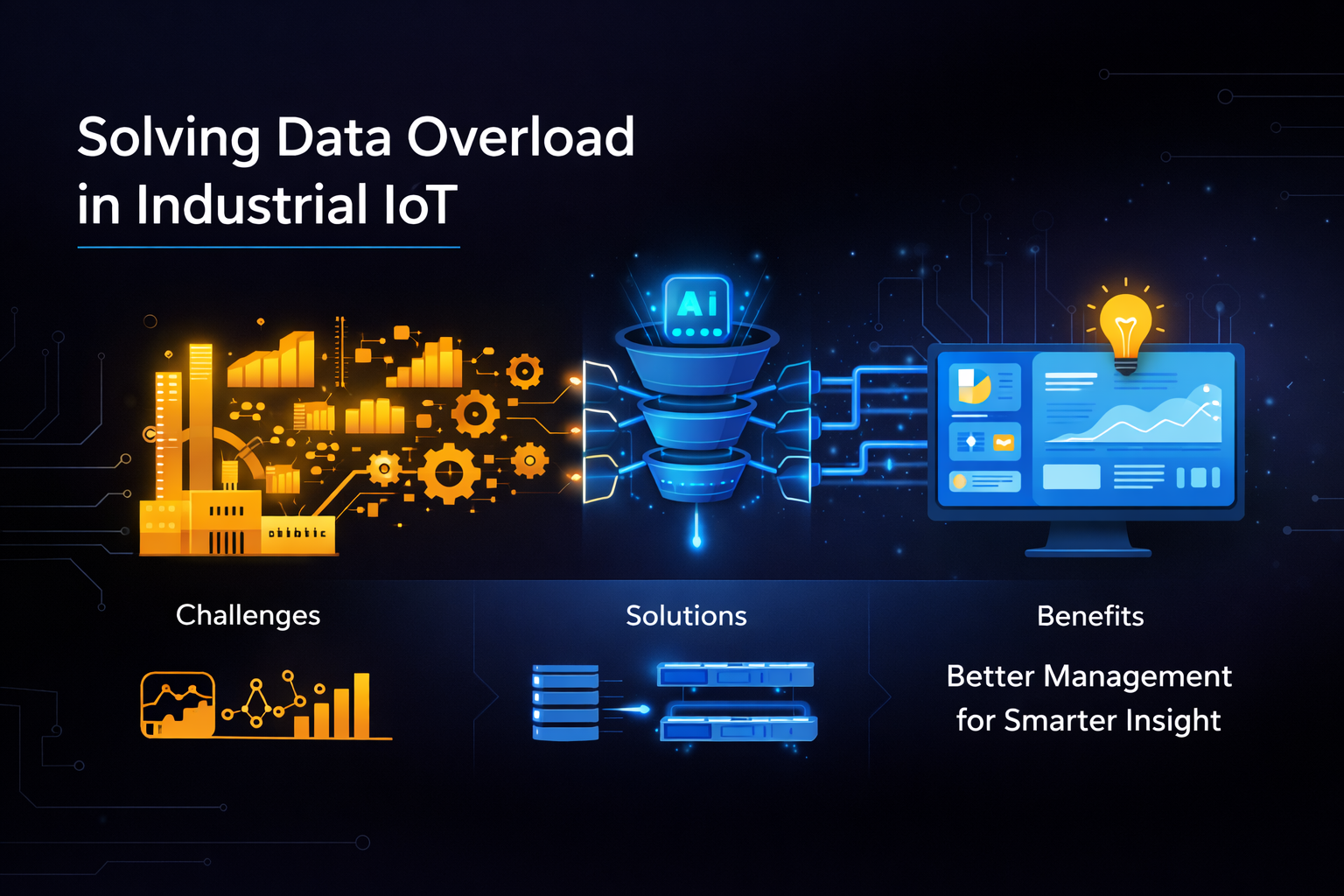
To solve the data overload problem, an iot solution provider must implement a multi-layered architecture. This structure ensures that data is refined as it moves through the system, much like raw material moving through a factory.
- Device Layer: High-fidelity sensors (vibration, acoustics, thermography) capture raw physical signals.
- Network Layer: Wired (Ethernet/IP) or wireless (5G, Private LTE) protocols transport data. In industrial settings, reliability and latency take precedence over raw speed.
- Edge Layer: This is where the first “pruning” occurs. Edge gateways run lightweight algorithms to detect anomalies locally. If a motor’s vibration is within normal parameters, the edge node might only send a summary heartbeat to the cloud rather than the raw high-frequency waveform.
- Cloud/Platform Layer: This layer handles long-term storage, complex digital twin modeling, and cross-facility benchmarking.
- API & Application Layer: The final stage where data becomes insight. APIs deliver processed information to ERP systems, maintenance dashboards, or mobile alerts for floor supervisors.
Strategic Data Management: Risks and Controls
Implementing IIoT at scale involves more than technical configuration; it requires a risk-based approach to data governance. The table below compares the traditional “Cloud-Only” approach with the modern “Edge-Cloud Hybrid” model favored by leading experts in 2026.
| Feature | Cloud-Only Model | Edge-Cloud Hybrid Model | Risk Mitigation |
| Data Latency | High (round-trip to data center) | Ultra-low (local processing) | Prevents delayed emergency shutdowns. |
| Bandwidth Cost | Prohibitive for high-frequency sensors | Optimized (only deltas are sent) | Lowers monthly operational expenses (OPEX). |
| Data Integrity | Dependent on constant connectivity | Resilient (local storage & forward) | Protects against data gaps during network outages. |
| Security Surface | Large (all raw data in transit) | Compact (data filtered/anonymized at source) | Reduces exposure of sensitive operational tech (OT). |
Moving Beyond Simple Thresholds: The Power of Anomaly Detection
Traditional monitoring relies on “threshold alarms”—for example, alerting a technician when a pump’s temperature exceeds 80°C. The problem with this approach is “alarm fatigue.” By the time a temperature threshold is breached, damage has often already occurred.
Smarter insight comes from behavioral baselining. Advanced IoT Dashboard Solutions now use machine learning to understand what “normal” looks like for a specific asset under specific load conditions. A motor running at 75°C might be perfectly healthy during a high-speed production run but indicative of a bearing failure during a low-speed cycle. By managing the data through a contextual lens, an iot solution provider helps operators focus only on true deviations, reducing “nuisance alarms” by up to 60%.
Real-World Case Example: Global Automotive Component Manufacturer
A Tier-1 automotive supplier with 14 global plants faced a critical bottleneck: their predictive maintenance pilot was generating 400GB of data per machine per day. Their cloud storage costs were skyrocketing, and the central maintenance team was overwhelmed by a “tsunami” of vibration data.
The IoT Development Company tasked with the overhaul implemented a “Smart Edge” strategy:
- Local FFT Analysis: Fast Fourier Transform (FFT) analysis was moved to the edge gateways. Instead of streaming raw vibration data, the gateways only sent “Health Indices” (e.g., misalignment score, looseness score).
- Event-Driven Uploads: High-resolution raw data was only uploaded to the cloud if the Edge AI detected a potential fault, allowing engineers to perform deep-dive forensics without the cost of continuous streaming.
- Cross-Plant Benchmarking: The cloud platform was repurposed to compare the efficiency of similar assets across all 14 plants.
The Result: The company reduced its data transmission costs by 85% while increasing the accuracy of its failure predictions by 22%.
Business Impact and ROI: The Measurable Gains
Solving data overload is not a “nice-to-have” technical fix; it is a financial imperative. Well-managed IIoT systems deliver measurable returns across three key pillars:
- Downtime Reduction: According to Deloitte, predictive maintenance can reduce unplanned downtime by an average of 70%. In heavy industries where an hour of downtime costs $50,000+, the ROI is realized within months.
- Asset Life Extension: Precise, condition-based intervention extends the useful life of machinery by 20-35%, delaying massive capital expenditures (CAPEX) for equipment replacement.
- Operational Efficiency (OEE): By identifying “micro-stops”—short, recurring pauses in production that go unnoticed by humans—companies typically see a 15-20% boost in Overall Equipment Effectiveness.
Final Thoughts
As we move deeper into 2026, the competitive advantage in industry will belong to those who can master the signal-to-noise ratio. Data is the new oil, but raw oil is useless without a refinery. By partnering with a seasoned IoT Development Company and adopting a layered, edge-heavy architecture, industrial enterprises can transform their overwhelming data streams into a clear, strategic roadmap for growth. Smarter insight doesn’t come from having more data; it comes from having the right data at the right time.
Frequently Asked Questions
1. Can I use IIoT for data management if my factory has legacy (Brownfield) equipment?
Absolutely. Modern solutions use non-invasive sensors (like magnetic vibration pods) and universal gateways that can “bridge” legacy protocols like Modbus or Serial to modern cloud APIs without requiring expensive PLC reprogramming.
2. Is Edge Computing more expensive to implement than Cloud-Only solutions?
While the initial hardware cost for “smart” gateways is slightly higher, the long-term savings in cloud storage, bandwidth, and improved response times usually result in a much lower Total Cost of Ownership (TCO).
3. How do I ensure my industrial data remains secure during transit?
Security must follow a multi-layered approach. Use TLS 1.3 encryption to protect data in transit, implement X.509 certificate-based authentication for every device, and ensure your IoT solution provider applies Confidential Computing to protect data even during processing.
4. What is the difference between “Big Data” and “Actionable Insight” in IoT?
Big Data is the raw volume of everything your sensors collect. Actionable Insight is the specific, filtered conclusion (e.g., “Bearing #4 on Conveyor B will likely fail in 48 hours”) that allows a human or system to take a corrective step.
5. How long does it typically take to see a return on investment (ROI) from an IIoT project?
Most focused pilot projects (Proof of Concept) show measurable ROI within 6 to 12 months. Scaling across a full enterprise typically sees a “payback period” of 18 to 24 months as operational efficiencies compound.

Casey Morgan is a Digital Marketing Manager with over 10 years of experience in developing and executing effective marketing strategies, managing online campaigns, and driving brand growth. she has successfully led marketing teams, implemented innovative digital solutions, and enhanced customer engagement across various platforms.