








































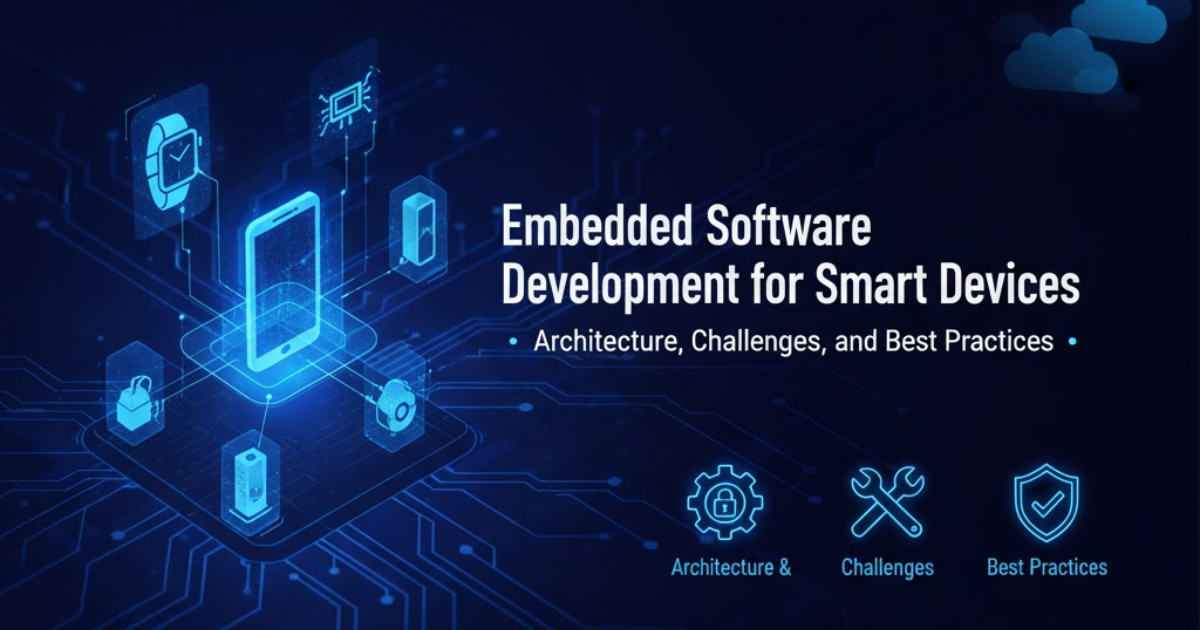
The proliferation of smart devices has fundamentally reshaped our interaction with technology, from intelligent home appliances to sophisticated industrial IoT sensors. At the core of this revolution lies embedded software – specialized software designed to control specific functions of non-computer devices.
This field is experiencing explosive growth, with the global embedded software market projected to reach USD 16.03 billion by 2029, exhibiting a compound annual growth rate (CAGR) of 7.0% from 2022 to 2029, according to Fortune Business Insights. Furthermore, the number of connected IoT devices is expected to exceed 29 billion by 2030 (Statista). This pervasive integration underscores the critical role of robust Embedded Software Development in building reliable and innovative smart solutions.
This article delves into the intricacies of embedded software development for smart devices, exploring architectural considerations, common challenges, and practical best practices for successful implementation.
Understanding the Architecture of Smart Device Embedded Software
The architecture of embedded software in smart devices is a multi-layered construct, often involving interactions across hardware, network, and cloud environments. A typical breakdown includes:
1. Device Layer
This is the foundational layer, encompassing the microcontroller or microprocessor, sensors, actuators, and memory. The embedded software directly interfaces with these hardware components, managing their operations, collecting data, and executing commands. Real-time operating systems (RTOS) are frequently employed here to ensure deterministic behavior and efficient resource management.
2. Connectivity/Network Layer
Smart devices are defined by their ability to communicate. This layer handles various communication protocols such as Wi-Fi, Bluetooth, Zigbee, LoRaWAN, or cellular (4G/5G). The embedded software manages connection establishment, data transmission, and network security, ensuring seamless data flow to and from the device.
3. Edge Layer (Optional but Increasingly Common)
For many smart devices, especially those in industrial or critical applications, some level of data processing and decision-making occurs at the “edge” – closer to the data source. This minimizes latency and bandwidth usage. Embedded software at this layer might perform data filtering, aggregation, local analytics, or even basic AI/ML inference before transmitting essential information to the cloud.
4. Cloud Layer
The cloud provides scalable storage, advanced analytics, remote management capabilities, and integration with broader enterprise systems. Embedded software often includes modules for secure data transfer to cloud platforms (AWS IoT, Azure IoT, Google Cloud IoT), where further processing, visualization, and application logic reside.
5. API Layer
Application Programming Interfaces (APIs) enable interaction between the embedded system and other applications, user interfaces, or third-party services. The embedded software exposes APIs for remote configuration, data retrieval, and control commands, facilitating integration into larger ecosystems.
6. Security Layer
Integrated across all layers, security is paramount in smart devices. This involves secure boot mechanisms, encryption for data at rest and in transit, secure over-the-air (OTA) updates, authentication protocols, and access control. Robust embedded software development prioritizes security from the initial design phase.
Key Challenges in Embedded Software Development
Developing embedded software for smart devices presents a unique set of challenges that demand specialized expertise.
- Resource Constraints: Unlike general-purpose computing, embedded systems often operate with limited CPU power, RAM, and storage. Developers must write highly optimized, efficient code to fit within these constraints while maintaining functionality and responsiveness.
- Real-time Requirements: Many smart devices, especially in industrial control or medical applications, demand deterministic behavior. Tasks must execute within strict deadlines, making real-time operating systems (RTOS) and careful task scheduling critical.
- Hardware-Software Integration: The tight coupling between hardware and software is a hallmark of embedded systems. Developers must possess a deep understanding of the underlying hardware, including datasheets, schematics, and peripheral operations, to write effective drivers and firmware.
- Power Management: For battery-powered smart devices, optimizing power consumption is a significant challenge. Embedded software must intelligently manage power states, peripheral usage, and communication cycles to maximize battery life.
- Security Vulnerabilities: As smart devices become ubiquitous, they become attractive targets for cyberattacks. Securing embedded systems from physical tampering, unauthorized access, and data breaches requires a multi-faceted approach, including secure coding practices, robust encryption, and secure update mechanisms.
- Reliability and Robustness: Smart devices often operate in harsh environments or critical applications where failure is not an option. The embedded software must be exceptionally reliable, fault-tolerant, and capable of recovering from errors gracefully.
- Over-the-Air (OTA) Updates: Managing firmware updates for deployed devices is complex. OTA update mechanisms must be secure, atomic (either fully applied or fully reverted), and robust enough to handle network interruptions or power failures during the update process.
Best Practices for Successful Embedded Software Development
Addressing these challenges requires a structured approach and adherence to best practices throughout the development lifecycle.
1. Start with a Clear Requirements Definition
Thoroughly define functional and non-functional requirements, including performance, power consumption, security, and reliability. Ambiguity here leads to significant rework later.
2. Hardware-Aware Design
Design the software with a deep understanding of the target hardware. This includes selecting appropriate microcontrollers, understanding memory maps, and optimizing peripheral usage. Collaborate closely with hardware engineers from the outset.
3. Modular and Layered Architecture
Employ a modular design where different functionalities are encapsulated into independent modules. A layered architecture separates concerns, improving maintainability, testability, and reusability.
4. Use an RTOS When Necessary
For systems with strict timing requirements, a real-time operating system (RTOS) like FreeRTOS, Zephyr, or µC/OS can simplify task scheduling, inter-process communication, and resource management.
5. Prioritize Security from Day One
Implement security measures throughout the design, development, and testing phases. This includes secure boot, hardware-based security features (e.g., TrustZone), encryption, secure communication protocols, and robust authentication. An Embedded Software Development Company often has specialized security architects to guide this process.
6. Robust Error Handling and Fault Tolerance
Implement comprehensive error detection and recovery mechanisms. This includes watchdog timers, brown-out detection, exception handling, and graceful degradation strategies to ensure system resilience.
7. Extensive Testing and Validation
Unit testing, integration testing, system testing, and regression testing are crucial. Hardware-in-the-Loop (HIL) testing and thorough validation under various real-world conditions help identify and mitigate issues before deployment.
8. Efficient Power Management Strategies
Implement power-saving modes (sleep, deep sleep), selectively power down unused peripherals, and optimize communication cycles to extend battery life.
9. Implement Secure and Reliable OTA Updates
Design an OTA update mechanism that ensures firmware integrity, authenticity, and atomicity. This is vital for maintaining security and delivering new features post-deployment.
10. Version Control and Documentation
Use robust version control systems (e.g., Git) and maintain thorough documentation of code, design decisions, and testing procedures.
Technical Architecture Breakdown: Smart Home Energy Monitor
Let’s illustrate these concepts with a simple smart home energy monitor:
1. Device Layer:
- Microcontroller: ESP32 (integrates Wi-Fi, Bluetooth).
- Sensors: Current transformers (CT clamps) to measure AC current; voltage sensor.
- Peripherals: ADC (Analog-to-Digital Converter) for sensor readings, GPIOs for status LEDs.
- Firmware: Written in C/C++ using ESP-IDF framework. Manages sensor readings, calculates power consumption, and handles Wi-Fi connectivity.
2. Connectivity Layer:
- Protocol: Wi-Fi (MQTT for messaging).
- Functionality: Connects to the home Wi-Fi network, establishes an MQTT connection to a broker.
3. Edge Layer:
- Functionality: The ESP32 firmware itself performs initial data filtering (e.g., smoothing noisy sensor data), calculates RMS voltage/current and real power, and aggregates data points before sending. This reduces the frequency of cloud communication.
4. Cloud Layer:
- Platform: AWS IoT Core.
- Services: Receives MQTT messages, stores data in DynamoDB, processes with AWS Lambda for alerts (e.g., high consumption), and provides data for a dashboard.
5. API Layer:
- Functionality: An AWS API Gateway exposes REST APIs for a mobile app or web dashboard to fetch historical energy data and set consumption thresholds.
6. Security Layer:
- Device: Secure boot, TLS for MQTT communication, secure storage of Wi-Fi credentials.
- Cloud: IAM policies for access control to AWS services, secure API keys.
Case Example: Industrial IoT Predictive Maintenance for Manufacturing
Consider a large manufacturing plant deploying smart sensors on critical machinery (e.g., CNC machines, robotic arms) for predictive maintenance. An Embedded Software Development Company was contracted to design the firmware for these sensors.
The sensors, equipped with accelerometers, temperature probes, and current sensors, run embedded Linux on ARM Cortex-A processors. The custom embedded software collects high-frequency vibration and thermal data. It performs local FFT (Fast Fourier Transform) analysis on vibration data at the edge to detect early signs of bearing wear or motor imbalance.
Only anomalous data patterns or aggregated health metrics are then securely transmitted via LoRaWAN to an on-premise edge gateway. From there, critical alerts and summary data are pushed to a cloud platform for long-term storage, advanced machine learning-driven anomaly detection across multiple machines, and integration with the plant’s Enterprise Asset Management (EAM) system. This approach significantly reduces data volume transmitted to the cloud while enabling real-time local anomaly detection, proving the power of edge computing.
Comparison Table: Risks and Controls in Embedded Software Development
| Feature/Area | High Risk Scenario | Recommended Control/Best Practice |
| Resource Use | Memory leaks, buffer overflows, inefficient loops | Static code analysis, memory profiling, precise resource allocation, using optimized libraries. |
| Real-time Mgmt. | Missed deadlines, task starvation | RTOS with priority-based scheduling, careful interrupt handling, deterministic execution paths, worst-case execution time (WCET) analysis. |
| Security | Unauthorized access, data breaches, malware | Secure boot, hardware security modules (HSMs), TLS/DTLS for communication, secure OTA updates, input validation, least privilege principle. |
| Reliability | System crashes, data corruption, unexpected reboots | Watchdog timers, robust error handling, power-fail detection, redundant systems (where critical), extensive testing and fault injection. |
| Power Mgmt. | Short battery life, excessive heat | Power-aware design, sleep modes, dynamic voltage/frequency scaling, judicious peripheral use, optimized communication protocols. |
ROI and Business Impact
Effective Embedded Software Development for smart devices yields substantial ROI through various channels:
- Cost Reduction: Predictive maintenance (as in the case study) reduces unplanned downtime by 10-40% and maintenance costs by 5-20% (Deloitte). Smart energy monitoring can cut utility bills by identifying inefficiencies.
- Improved Efficiency: Automation through smart devices optimizes processes, reducing manual labor and improving operational efficiency.
- Enhanced Product Performance: Well-developed embedded software leads to more reliable, responsive, and feature-rich products, boosting customer satisfaction and brand reputation.
- New Revenue Streams: Smart devices enable data-driven services, subscription models, and personalized experiences, opening new avenues for revenue generation.
- Faster Time-to-Market: Adhering to best practices, including robust testing and modular design, streamlines the development process, accelerating product launch.
For example, a company implementing smart thermostats with advanced embedded algorithms for learning user preferences can demonstrate significant energy savings for customers (e.g., 10-15% reduction in heating/cooling costs), leading to higher product adoption and customer loyalty.
Final Thoughts
The landscape of smart devices is evolving rapidly, driven by continuous innovation in embedded systems. Successful Embedded Software Development is the cornerstone of this evolution, demanding a blend of hardware acumen, software engineering prowess, and a keen eye for security and reliability.
By embracing robust architectures, meticulously addressing challenges, and adhering to industry best practices, developers and organizations can unlock the full potential of smart devices, delivering intelligent, efficient, and transformative solutions across every sector. The future of connectivity and automation rests firmly on the capabilities of well-engineered embedded software.

Casey Morgan is a Digital Marketing Manager with over 10 years of experience in developing and executing effective marketing strategies, managing online campaigns, and driving brand growth. she has successfully led marketing teams, implemented innovative digital solutions, and enhanced customer engagement across various platforms.