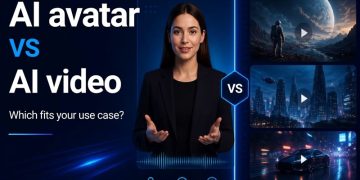







































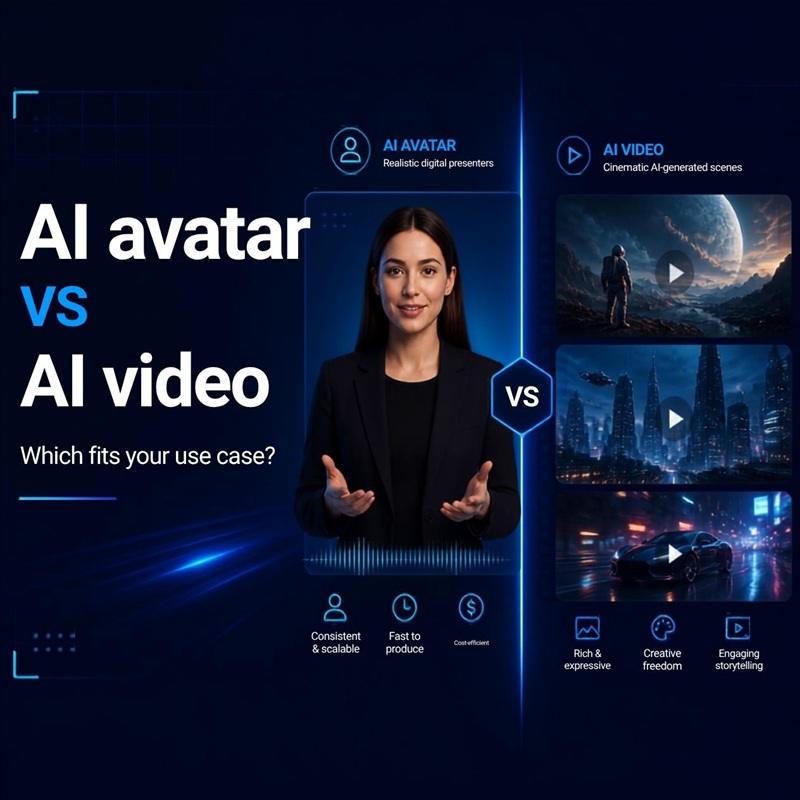
Anyone making videos with AI eventually runs into the AI avatar vs AI video decision: should the video be led by an avatar speaking to camera, or built from AI-generated scenes with no presenter at all?
It’s an easy decision to get wrong, because both formats can technically produce a finished video for almost any brief. The difference shows up later — in whether the video actually does its job. A testimonial-style ad without a presenter can feel hollow, and a cinematic brand film with a talking-head avatar can feel oddly stiff, even if both are well produced. The mismatch usually isn’t a quality problem. It’s a format problem.
There’s no universal answer to the AI avatar vs AI video question — it depends entirely on what the video needs to do, who it’s for, and where it’s going to be watched. A testimonial ad and a cinematic brand film are solving different problems, and the right format follows the purpose, not the other way around. This piece walks through the use cases where each approach tends to work best, why that pattern holds, and where combining both formats in one video makes more sense than picking a side.
When AI avatar video works better
An avatar works well any time the video’s job is to build trust, explain something, or feel like a person is talking directly to the viewer. The common thread across these use cases is that the message matters more than the visual world around it.
UGC-style ads and testimonials. Performance ads that mimic organic, creator-style content rely on a presenter — the format only works if it feels like a real person recommending something, not a produced sequence of shots. If you’re testing this format for paid social, it’s worth looking at how UGC-style AI video is typically structured before scripting one.
Explainers and tutorials. When the goal is to walk someone through a process, a consistent presenter delivering the explanation tends to hold attention better than cutaways between abstract visuals. Viewers following a step-by-step process benefit from a stable reference point rather than a changing scene every few seconds — it reduces the cognitive load of following along.
Training and onboarding content. Internal training videos are usually about clarity and repetition, not visual spectacle. A steady, consistent presenter across many modules keeps the format predictable for viewers who are watching to learn, not to be entertained. This also matters operationally — a training library with dozens of modules is easier to maintain and update when the presenter format stays consistent across all of them.
Founder and spokesperson videos. Messages that are meant to feel personal — a founder update, a company announcement, a leadership message — depend on a face people can connect the message to. These videos are rarely about visual variety; they’re about the message landing as if it came from a specific person, which is exactly what an avatar format is built for.
Education and classroom-style content. Lessons that involve a “teacher” explaining a concept to a “student” benefit from a presenter format, especially when the content needs to be produced at volume across many topics. Education content also tends to be revisited and referenced later, and a familiar presenter across a course or curriculum helps that continuity.
When AI video, built from AI-generated scenes, works better
Scene-based AI video works well when the job is to show something, tell a story, or create a mood — not deliver a message from a person. Here the common thread flips: the visual world is doing the work the message would otherwise have to do.
Product videos. When the product itself needs to be shown in different settings, angles, or contexts, scene generation does the work a presenter format can’t — there’s no one to “talk about” the product because the product is the subject. A product-focused AI video built from multiple scenes often performs better on screen than one built around a presenter narrating over static shots.
Cinematic brand campaigns. Brand films built around mood, visual storytelling, and atmosphere are usually stronger without a presenter breaking the cinematic feel. These videos are typically less about conveying specific information and more about building an impression — and a talking presenter tends to pull attention toward the message rather than the mood the video is trying to create.
Explainers that are conceptual rather than instructional. Some explainer content works better through visual metaphor and scene changes than through a person talking — this depends on the message, not the category. A video explaining an abstract idea, such as a process, an industry shift, or a before-and-after concept, can often communicate faster through visuals than through spoken explanation alone.
Brand storytelling. Multi-scene narratives that follow a story arc, such as a customer journey, a before-and-after, or a campaign concept, need the flexibility to move between locations, characters, and moments that scene generation supports. This kind of narrative-driven AI video tends to flatten into a single point of view if a presenter format is used instead, which works against the format’s strength.
AI avatar vs AI video: use case guide
| Use case | Recommended format |
| UGC-style ads and testimonials | AI avatar |
| Product demos and product videos | AI video (scenes) |
| Explainers and tutorials | AI avatar |
| Training and onboarding | AI avatar |
| Founder or spokesperson videos | AI avatar |
| Cinematic brand campaigns | AI video (scenes) |
| Brand storytelling and narrative ads | AI video (scenes) |
| Educational / classroom-style content | AI avatar |
This is a starting point, not a rule. Some of these use cases genuinely work either way depending on tone and platform — a founder video for a serious B2B audience and a founder video for a casual social following can call for different treatments even within the same category. The exceptions matter more than the table.
Combining AI avatar and AI video in one project
A lot of real campaigns don’t fit neatly into one category. It’s common for a single video to open with an avatar-led testimonial or spokesperson segment, then move into scene-based visuals to show the product or brand world in action. A training video might use an avatar for instruction but cut to generated scenes to illustrate a process the presenter is describing. A brand film might use a presenter for the opening hook, to establish trust or context quickly, then shift into cinematic storytelling for the rest of the video once attention is secured.
The deciding factor isn’t the format itself — it’s whether a particular moment in the video needs a person delivering a message, or a scene showing something. Longer or more complex videos often need both at different points, and treating the choice as one-or-the-other for the entire video can work against what the content is actually trying to do at each stage.
AI avatar vs AI video: the real question to ask
Instead of asking whether to use an avatar or scenes, a more useful question is: does this specific video need someone to say something, or does it need to show something? Messages, explanations, and trust-building content usually lean toward a presenter. Stories, products, and mood-driven content usually lean toward scenes. Many videos need both at different moments, which is increasingly common as production tools support mixing formats within a single project. Platforms like Intellemo, for instance, support both AI avatar video generation and AI text-to-video generation within the same workflow, which is useful when a video needs to move between the two rather than commit to one format entirely.
There’s no format that’s better across the board. The right one depends on what a specific video is trying to do, and increasingly, for longer or more layered projects, the answer is both.
Frequently asked questions about AI avatar vs AI video
Should a SaaS product video use an AI avatar or AI-generated scenes? It depends on what the video needs to do. A SaaS explainer walking someone through how the product works usually benefits from an avatar, since the format supports step-by-step delivery and a consistent presenter across a product’s feature set. A SaaS brand or launch video meant to build visual impression rather than explain functionality tends to work better as scene-based, especially when it needs to show the product in use across different contexts.
Which format works better for a founder update aimed at investors versus one aimed at social media? Both are typically avatar-led, since the format depends on trust and personal delivery rather than platform. What changes between the two is tone and pacing, not the underlying format choice.
Can training and onboarding videos ever use AI-generated scenes instead of an avatar? Yes, in parts. A presenter is usually better for direct instruction, but scenes are often used within the same video to illustrate a process, workflow, or example the presenter is describing. The presenter carries the instruction; the scene carries the illustration.
Is a product demo always better as AI-generated scenes? Not always. A product demo that needs someone to walk through features step by step (common for software or app demos) often works better with an avatar guiding the viewer. A product demo built around showing a physical product in use, in different settings, tends to work better as scene-based.
How do I decide the format for a video that has both instructional and storytelling goals? Break the video down by moment rather than by video. If a section is delivering information or building trust, lean avatar. If a section is meant to show something or set a mood, lean scenes. Many videos end up combining both rather than picking one format for the entire runtime.
Does the target platform (YouTube, Instagram, LinkedIn) change whether to use an avatar or scenes? Platform affects pacing and length more than the core format decision. The underlying question stays the same regardless of platform: does this video need someone saying something, or does it need to show something. What usually changes by platform is how quickly that decision needs to be established at the start of the video.