









































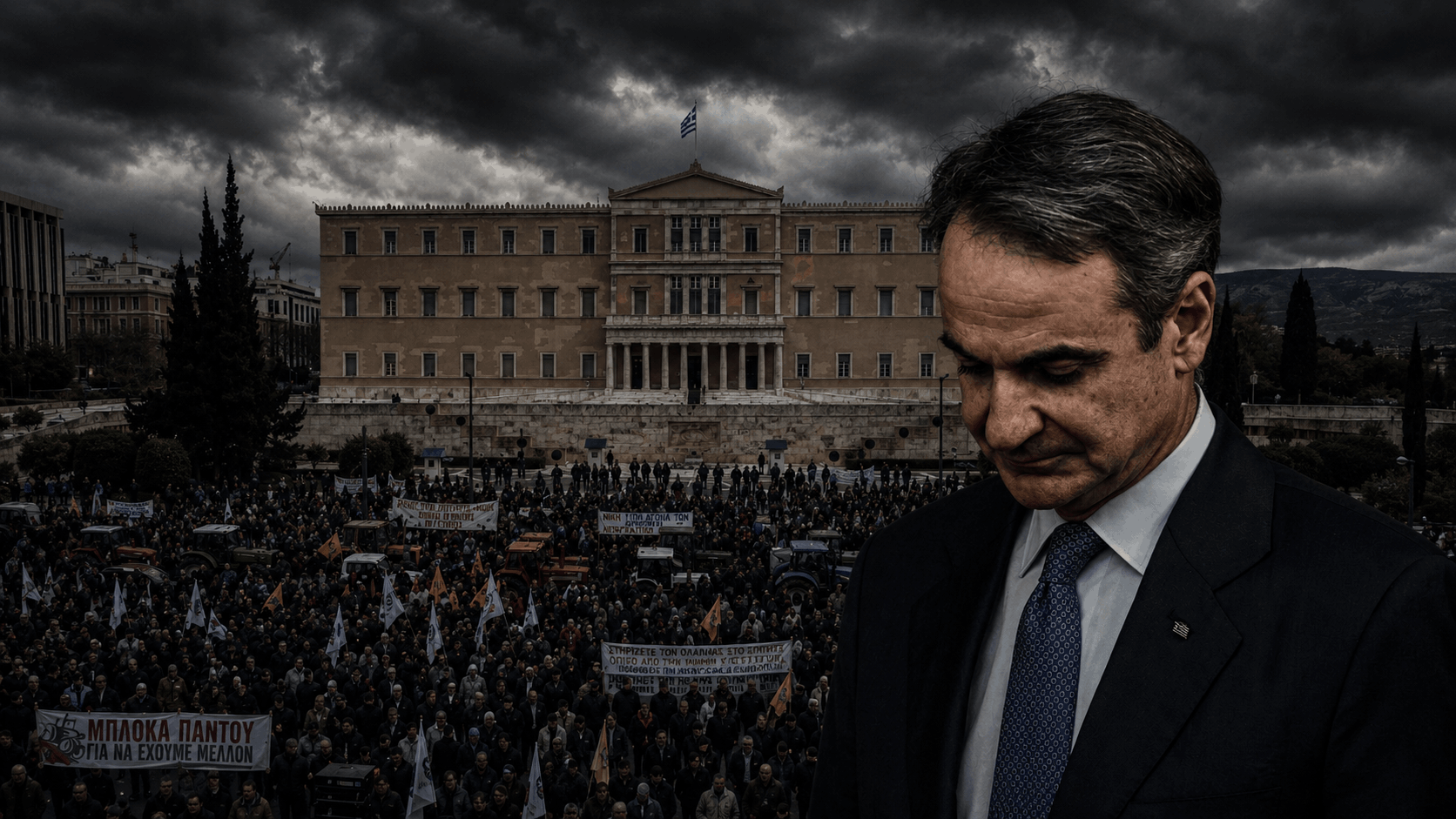
Kyriakos Mitsotakis has spent years presenting himself as the leader who stands between Greece and political disorder. It was a persuasive argument when he first came to power: a polished, pro-European conservative promising competence after years of crisis, reform after years of drift, and stability after a period in which many voters had lost faith in the country’s political system.
That argument is now far less convincing. After years in office, Mitsotakis can no longer campaign simply as the alternative to instability, because the instability now threatening Greece is tied directly to the way his own government has exercised power. New Democracy may remain ahead of its rivals, and the opposition may still be fragmented, but neither of those facts can disguise the erosion of Mitsotakis’ central claim: that he alone can provide order, seriousness and effective government.
The record is increasingly difficult for him to defend. His administration promised transparency and institutional renewal, yet it has been repeatedly damaged by controversies that have raised questions about accountability, oversight and the relationship between political power and the state. The surveillance affair weakened public confidence in democratic safeguards. The Tempi rail disaster exposed serious failures in public administration and safety. The farm-subsidy scandal reinforced the suspicion that public money, political influence and entrenched networks remain too closely connected.
Taken together, these episodes have damaged more than the government’s reputation. They have undermined the very image Mitsotakis built his leadership around. He was supposed to be the moderniser who would distance Greece from old habits of patronage, opacity and institutional weakness. Instead, his government increasingly appears to have adapted to those habits while presenting them in a more polished and internationally acceptable form.
That is why his warning about instability now sounds less like a serious national argument and more like a survival strategy. Mitsotakis argues that Greece needs a strong New Democracy majority to avoid paralysis, but his own majority government has not delivered the clean break he promised. He warns against coalitions because they could slow decision-making, yet the deeper issue is that coalition politics would limit the personal control he has enjoyed. He asks voters to fear uncertainty, while offering little proof that another term would produce the institutional change and accountability Greece needs.
This is the weakness at the heart of his third-term ambition. Mitsotakis is not asking voters to endorse a clear new programme for the country so much as to extend the authority of a political leader whose strongest argument is that the alternatives are worse. That may still be an effective electoral tactic, especially in a divided political landscape, but it is not a vision. It is defensive politics built around fear, fatigue and the hope that voters will choose the familiar over the unpredictable.
The Election Trap Facing New Democracy
The next election could expose just how fragile that strategy has become. If New Democracy fails to secure an outright majority, every available route carries political damage. A second election would look like an attempt to pressure voters into giving Mitsotakis full control. A coalition would confirm that the era of personal dominance is over. A deal with PASOK would be difficult for both sides, particularly after years of confrontation over democratic standards and the surveillance scandal. A turn towards parties further to the right would raise serious questions about the substance of Mitsotakis’ centrist, liberal-conservative image.
None of those outcomes would strengthen the stability narrative. On the contrary, they would reveal how dependent that narrative has become on one condition: Mitsotakis governing alone. Once that condition disappears, the prime minister’s claim to be the guarantor of order begins to look much less like a principle and much more like a demand for unchecked authority.
PASOK has little incentive to rescue him. If it were to enter a Mitsotakis-led government, it would risk being seen as an accessory to New Democracy rather than a genuine alternative. For a party trying to rebuild its identity and credibility, especially among voters disillusioned with the current government, that would be a dangerous calculation. At the same time, cooperation with forces further to the right would be equally damaging for Mitsotakis, because it would suggest that the pro-European moderation he has carefully cultivated is negotiable when power is at stake.
A broader multi-party arrangement would not necessarily offer a solution either. Greece has experience with governments formed out of necessity rather than conviction. They may survive administratively, but they rarely produce deep reform. Parties protect themselves, responsibility is diluted, and difficult decisions are postponed until the next crisis. In such a setting, accountability becomes blurred and governing becomes an exercise in managing decline rather than changing direction.
Mitsotakis Cannot Blame the Opposition Forever
This is the political dead end Mitsotakis has helped create. For years, he has reduced the country’s choice to a simple formula: his leadership or chaos. After two terms in power, that formula no longer works as cleanly as it once did. The sources of disorder are not only outside his government. They are found in the scandals his administration has struggled to escape, in the institutions whose credibility has been weakened, in the public distrust that has grown under his watch, and in a ruling party that may eventually begin to calculate whether it can preserve power more easily without him.
The opposition’s weaknesses are real. Alexis Tsipras remains a divisive figure. PASOK still struggles to convince voters that it is ready to lead. Smaller parties are fragmented, often protest-driven and in many cases untested as forces of government. But none of that absolves Mitsotakis. A prime minister who has governed for years cannot ask to be judged only against the failures of his opponents. He must be judged against his own promises.
On that test, his record is weak. He promised a more capable state, yet Greece still suffers from deep problems of administration, accountability and trust. He promised institutional seriousness, yet his government has repeatedly faced controversies that raised serious questions about the use and oversight of power. He promised stability, yet the country may now be heading towards repeat elections, difficult coalition bargaining or a government assembled more out of necessity than public confidence. He promised modernisation, but too often that modernisation has looked like a polished language of reform placed over familiar structures of control.
The danger for Mitsotakis is that his third-term campaign may come to be seen less as a national project and more as an effort at political self-preservation. He is not clearly offering Greece a new settlement or a serious plan to repair trust in institutions. He is asking voters to keep him at the centre of the system because the system around him is weak, divided and uncertain.
That is not the same as stability. In a healthy democracy, stability does not depend on one leader remaining in office. It depends on institutions strong enough to withstand changes of government, mechanisms of accountability that function regardless of who holds power, and public confidence that the state belongs to citizens rather than to parties and networks.
Mitsotakis once benefited from the belief that he could deliver exactly that. Now, after years in power, he is increasingly vulnerable to the charge that he has preserved the system more than he has reformed it. His government may still survive, and New Democracy may still finish first, but survival alone will not restore the credibility of a political project that has lost much of its original force.
The myth of Mitsotakis as Greece’s indispensable guarantor of stability is fading. What remains is a prime minister asking for another mandate in a country where the opposition is weak, the political class is splintered and voters are exhausted. That may be enough to keep him competitive, but it is not enough to make him convincing.
Greece does not need another lecture about instability from a leader whose own record has contributed to it. It needs accountability, institutional repair and a political system capable of renewing itself without pretending that one man’s survival is the same as national stability.