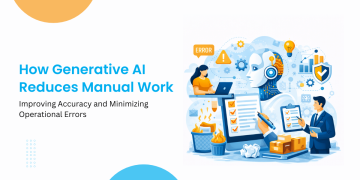














































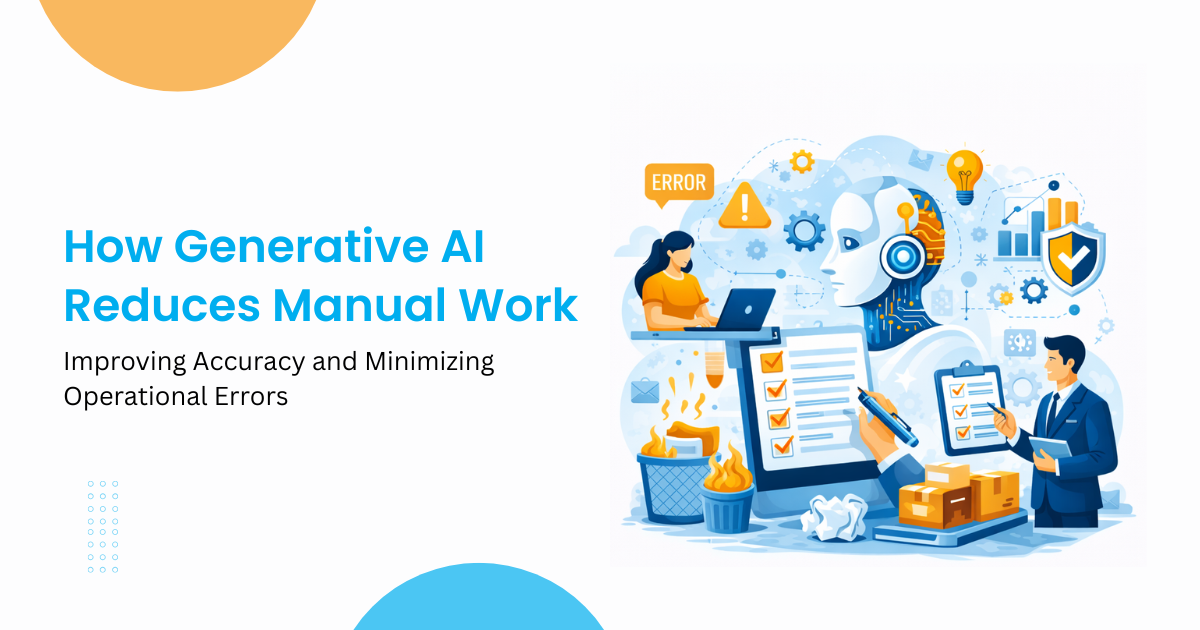
Manual processes remain a major challenge for modern businesses. According to a 2024 McKinsey report, nearly 60 percent of workplace tasks still involve repetitive manual work, despite growing digital adoption. Another recent industry study shows that human error contributes to almost 30 percent of operational inefficiencies across finance, operations, and customer support functions. These inefficiencies increase costs and slow decision-making.
Generative AI has emerged as a practical solution to address these problems. Unlike traditional automation, generative AI can understand context, generate content, and support decision-making. Businesses increasingly collaborate with a Generative AI Development Company to design systems that reduce manual effort and minimize errors. This article explains how generative AI achieves these outcomes through real operational use cases and technical insights.
How Manual Work Leads to Errors
Manual work often involves repetitive tasks such as data entry, document processing, reporting, and customer communication. These tasks consume time and introduce inconsistencies.
Human errors occur due to fatigue, context switching, and incomplete information. Even well-trained teams make mistakes when handling large data volumes. Traditional rule-based automation struggles with unstructured data and changing requirements.
Generative AI addresses these gaps by learning patterns from data and producing context-aware outputs. It adapts to variations rather than following rigid rules. This adaptability makes it suitable for complex business environments where accuracy and efficiency matter.
Automating Content and Documentation Tasks
Content creation remains a time-consuming activity across departments. Teams manually draft reports, emails, policies, and product descriptions.
Generative AI models generate structured text based on input data and guidelines. They reduce drafting time while maintaining consistency. Businesses still apply human review, but initial creation becomes faster and more reliable.
Common applications include:
- Internal reports and summaries
- Customer communication drafts
- Knowledge base documentation
By reducing repetitive writing tasks, teams focus on review and decision-making instead of creation.
Reducing Errors in Data Processing
Data processing often involves copying, formatting, and validating information. Manual handling increases the risk of missing values or incorrect entries.
Generative AI systems extract and interpret data from documents, emails, and forms. They identify patterns and flag inconsistencies. This reduces dependency on manual checks.
For example, generative models process invoices and contracts with varying formats. They extract relevant fields and highlight anomalies. Businesses achieve higher accuracy without increasing manual workload.
Improving Customer Support Accuracy
Customer support teams handle large volumes of queries daily. Manual responses lead to inconsistency and delayed resolution.
Generative AI assists agents by generating suggested responses based on context and history. It also summarizes past interactions to reduce reading time.
Key benefits include:
- Faster response preparation
- Reduced miscommunication
- Consistent tone and information accuracy
Support teams retain control, but AI reduces repetitive typing and lookup errors.
Supporting Software Development Workflows
Manual coding support tasks slow down development teams. Developers spend time on documentation, test case writing, and code reviews.
Generative AI supports these workflows by generating code snippets, comments, and test cases. It analyzes patterns rather than replacing developer judgment.
This support reduces oversight errors, such as missing edge cases or incomplete documentation. Development teams improve productivity while maintaining quality standards.
Enhancing Decision Support with Context Awareness
Manual analysis of reports and dashboards often leads to misinterpretation. Decision-makers struggle to connect insights across data sources.
Generative AI summarizes trends, explains anomalies, and answers natural language queries. It reduces the cognitive load on teams.
For instance, managers ask questions like “Why did order delays increase last week?” AI analyzes data and provides structured explanations. This reduces interpretation errors and speeds up decisions.
Customization for Business-Specific Workflows
Generic AI tools rarely fit complex business processes. Each organization follows unique workflows, data structures, and compliance rules.
Custom generative AI solutions adapt models to internal data and processes. They apply business logic during generation and validation. This customization ensures accuracy and relevance.
A Generative AI Development Company designs systems that align with operational realities. Customization reduces false outputs and improves trust in AI-assisted work.
Integration with Existing Systems
Manual work often exists because systems do not communicate effectively. Employees move data between tools manually.
Generative AI integrates with CRM, ERP, and document systems. It acts as an intelligent layer rather than replacing existing platforms.
Integrated systems reduce re-entry errors and improve data consistency. Employees work within familiar tools while AI handles background processing.
Managing Risk and Human Oversight
Reducing errors does not mean removing human control. Effective AI systems support human-in-the-loop workflows.
Businesses define review checkpoints and confidence thresholds. AI handles repetitive work, while humans validate critical outputs. This balance improves accuracy and accountability.
Clear governance policies ensure responsible AI usage. Businesses maintain compliance while benefiting from reduced manual effort.
Measurable Operational Impact
Organizations adopting generative AI report measurable improvements. Reduced task completion time, lower error rates, and improved employee satisfaction are common outcomes.
Teams spend less time correcting mistakes and more time on value-driven work. Over time, these gains translate into cost savings and improved service quality.
Results depend on data quality, integration, and governance. Careful implementation ensures sustainable benefits.
Building Trust Through Transparent AI Design
Trust plays a critical role in adoption. Employees must understand how AI supports their work.
Transparent model behavior, explainable outputs, and audit trails build confidence. Training programs help teams use AI effectively.
A responsible approach strengthens long-term adoption and reduces resistance.
Conclusion
Manual work and human errors continue to limit business efficiency. Generative AI offers a practical way to address these challenges without disrupting operations. By automating repetitive tasks, improving accuracy, and supporting decision-making, AI reduces operational friction.
Organizations that invest in Custom generative AI solutions gain systems tailored to real workflows. Partnering with a Generative AI Development Company ensures proper design, integration, and governance. When implemented responsibly, generative AI becomes a reliable support system that improves accuracy and frees teams to focus on higher-value work.
FAQs
- How does generative AI reduce manual work?
It automates repetitive tasks like content creation, data processing, and summarization. - Can generative AI reduce human errors?
Yes, it minimizes data handling mistakes and improves consistency. - Is human review still required?
Yes, human oversight ensures accuracy and responsible use. - Why are custom generative AI solutions important?
They align AI outputs with specific business workflows and data. - How long does it take to see results from generative AI?
Most businesses see efficiency gains within a few months of deployment.

Casey Morgan is a Digital Marketing Manager with over 10 years of experience in developing and executing effective marketing strategies, managing online campaigns, and driving brand growth. she has successfully led marketing teams, implemented innovative digital solutions, and enhanced customer engagement across various platforms.