










































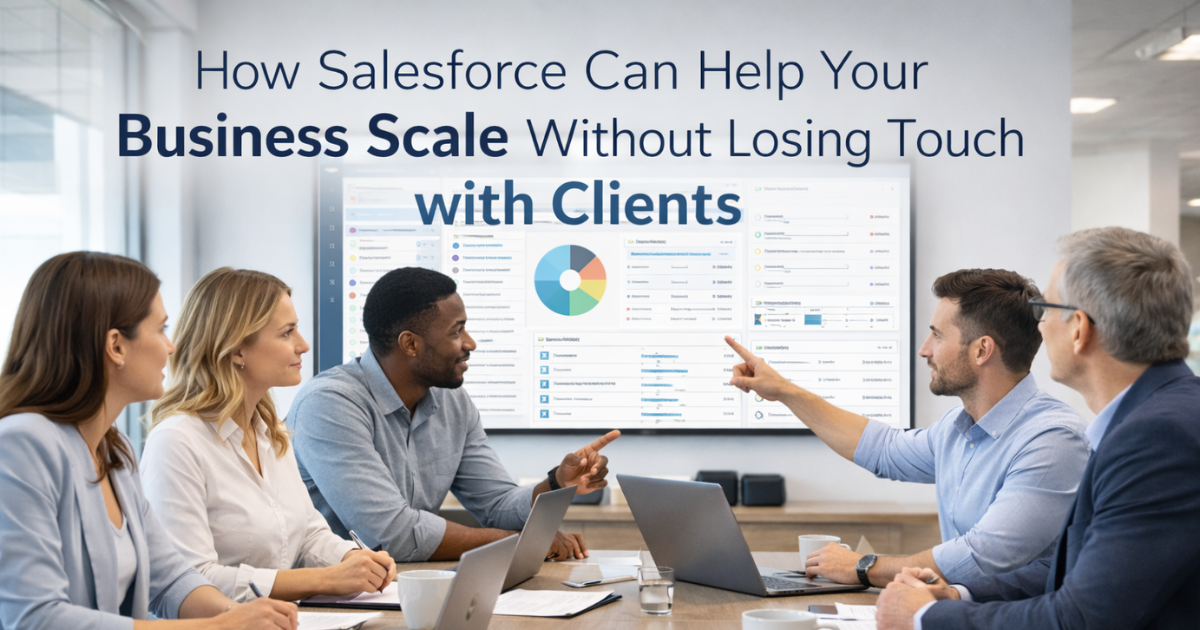
In 2025, customer experience research shows that 73% of buyers expect companies to understand their needs across every interaction. At the same time, scaling businesses report a 28% drop in customer satisfaction during rapid growth phases. These figures highlight a common challenge. Growth often creates distance between organizations and their clients.
Salesforce addresses this challenge when implemented with discipline. It supports scale while preserving visibility, accountability, and relationship context. This article explains how Salesforce enables growth without eroding client trust. The focus remains on system design, data management, and operational execution rather than marketing claims.
Why Growth Often Weakens Client Relationships
As businesses expand, teams multiply and processes fragment. Client information spreads across departments and tools. Personal knowledge becomes institutional data.
Common issues during growth include:
- Inconsistent client communication
- Loss of historical context
- Delayed responses
- Fragmented ownership
These problems do not result from intent. They result from systems that fail to adapt. Salesforce provides a shared operational layer that prevents these gaps when configured correctly.
Centralizing Client Information at Scale
Client data often exists in silos during early growth stages. Sales, support, and marketing teams store information separately.
Salesforce centralizes this data into unified records. Accounts, contacts, activities, and history remain accessible across teams.
Benefits of Centralization
- Teams see complete interaction histories
- Ownership remains clear across departments
- Transitions between teams become smoother
Centralization supports continuity. Clients do not need to repeat information. Teams make informed decisions faster.
Maintaining Personal Context Through Data Design
Scaling requires structure, but structure should not remove context. Salesforce allows teams to preserve relationship details through thoughtful data design.
Key design considerations include:
- Custom fields for client preferences
- Activity tracking for calls and meetings
- Relationship mapping between stakeholders
When designed well, Salesforce records reflect real relationships rather than abstract data. This detail supports meaningful engagement at scale.
Supporting Consistent Communication Across Teams
As headcount increases, communication styles often diverge. Clients notice inconsistency quickly.
Salesforce supports consistency through shared visibility. Email integration, task tracking, and activity timelines keep teams aligned.
Communication Controls That Matter
- Standardized follow-up processes
- Shared visibility into open issues
- Defined response timelines
Consistency does not mean rigidity. It ensures reliability while allowing teams to adapt tone and approach.
Scaling Sales Without Losing Trust
Sales growth introduces new representatives and territories. Clients often feel disconnected during these transitions.
Salesforce mitigates this risk through structured account management. Opportunity tracking, notes, and handover records maintain continuity.
Sales Scaling Practices Supported by Salesforce
- Clear account ownership
- Defined handoff processes
- Historical deal visibility
These practices reduce friction during team changes. Clients experience continuity despite internal growth.
Using Automation Without Losing the Human Element
Automation supports scale, but misuse creates distance. Salesforce automation works best when it supports, not replaces, human judgment.
Effective automation focuses on:
- Task reminders
- Status updates
- Internal alerts
Avoid automating client-facing decisions without oversight. Human review preserves empathy and context.
Organizations often rely on a Salesforce Development Company to design balanced automation. This approach prevents overengineering and preserves flexibility.
Personalization at Scale Through Data Segmentation
Scaling businesses serve diverse client needs. Treating all clients the same reduces relevance.
Salesforce enables segmentation through structured data and reporting. Teams group clients based on behavior, value, or needs.
Practical Segmentation Examples
- Account tier based on revenue
- Engagement level tracking
- Support priority indicators
Segmentation supports tailored communication without increasing manual effort.
Maintaining Service Quality During Growth
Support teams often feel strain during scaling phases. Case volume increases while response expectations remain high.
Salesforce Service Cloud supports structured service delivery. Case routing, priority rules, and escalation paths maintain responsiveness.
Key service capabilities include:
- Defined service level targets
- Clear case ownership
- Visibility into backlog trends
These tools help teams scale support without losing accountability.
Cross-Team Collaboration as the Organization Grows
Growth increases specialization. Without coordination, specialization creates silos.
Salesforce supports collaboration through shared records and internal communication tools. Teams coordinate within the same system rather than across disconnected platforms.
Collaboration Benefits
- Faster issue resolution
- Reduced miscommunication
- Shared accountability
Collaboration becomes a system behavior rather than an individual effort.
Reporting That Preserves Client Focus
As businesses scale, leadership often prioritizes volume metrics. This shift risks ignoring relationship quality.
Salesforce reporting balances growth metrics with client health indicators.
Important relationship-focused metrics include:
- Response time trends
- Engagement frequency
- Case resolution quality
These insights help leaders detect issues before clients disengage.
Customization to Support Unique Growth Models
Not all businesses scale the same way. Some expand geographically. Others diversify services.
Salesforce supports these models through configuration and development. Custom objects, workflows, and integrations adapt the platform to business realities.
Salesforce Development Services support advanced requirements such as:
- Complex account hierarchies
- Multi-brand operations
- Industry-specific data models
Customization should follow governance standards to avoid long-term complexity.
Governance as a Scaling Requirement
Scaling without governance leads to inconsistency. Salesforce requires oversight to remain effective.
Strong governance includes:
- Clear ownership of configuration
- Controlled change processes
- Regular system reviews
Governance ensures Salesforce evolves alongside the business rather than reacting to problems.
Training Teams as the Organization Expands
New hires join rapidly during growth. Without structured onboarding, system usage becomes inconsistent.
Salesforce training should focus on:
- Role-specific workflows
- Data quality expectations
- Client interaction standards
Ongoing training supports consistent client experiences across teams.
Example from a Growing B2B Firm
A B2B technology firm doubled its customer base within two years. Client satisfaction began to decline. Account transitions caused confusion.
The firm redesigned Salesforce account structures and introduced clear ownership rules. Automation supported internal alerts. Reporting tracked engagement gaps.
Within six months, response times improved by 30%. Client retention stabilized. Teams regained confidence in their data.
Security and Trust During Expansion
Growth increases data exposure risk. Salesforce security features protect client information when configured correctly.
Key controls include:
- Role-based access
- Field-level security
- Audit tracking
Security reinforces trust, especially as teams expand.
Conclusion
Scaling a business often creates distance between organizations and their clients. Salesforce addresses this risk when implemented with intention and discipline.
Centralized data, consistent communication, balanced automation, and governance support growth without sacrificing relationships. Salesforce Development Services extend platform capabilities for complex needs. An experienced Salesforce Development Company helps align system design with operational realities.
When Salesforce reflects how teams actually work, businesses grow while maintaining trust, continuity, and client connection.

Casey Morgan is a Digital Marketing Manager with over 10 years of experience in developing and executing effective marketing strategies, managing online campaigns, and driving brand growth. she has successfully led marketing teams, implemented innovative digital solutions, and enhanced customer engagement across various platforms.